

How an unfamiliar market condition turns a demand forecast into a supply chain problem
An illustration of why a forecasting model is most confident where it has least footing, and how Squint Vision Studio separates the forecasts it can support from the ones it cannot.
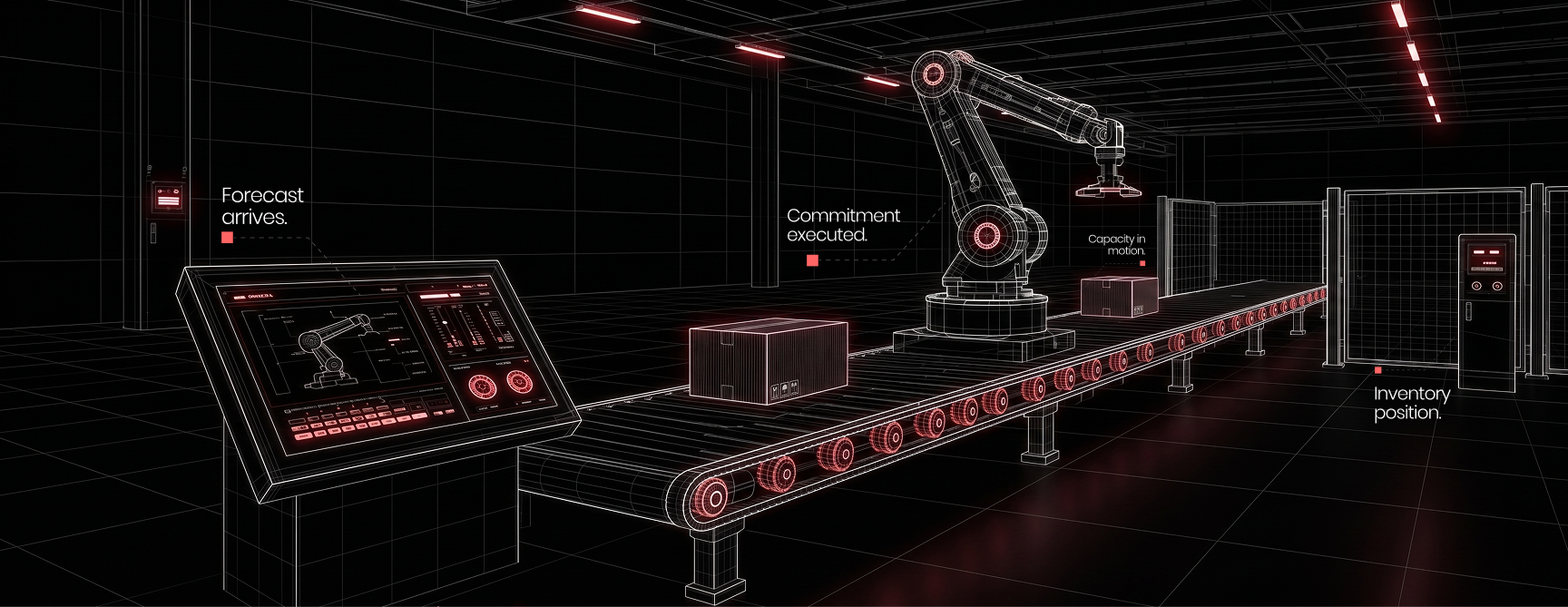
A demand forecasting model learns the structure of historical demand and projects it forward. This works because most demand is genuinely structured. It has trend, seasonality, and predictable responses to known drivers such as price and promotion. Inside that structure the model performs well, and years of accurate forecasts build justified trust in it.
The events that matter most to a supply chain are the ones that break the structure. A supply disruption, a competitor leaving the market, a regulatory change, a sudden shift in customer behaviour, an economic shock. Each of these is a regime change, a moment when the relationship between the past and the future stops holding.
Regime changes are underrepresented in training data by definition, because they are rare and often unprecedented. The model has learned the world as it was, and a regime change is the world becoming something else. Asked to forecast through one, the model does what it always does. It extrapolates from the patterns it knows and produces a confident number built on a structure that no longer applies.

The forecast looks the same on the worst week of the year
Some error during a disruption is unavoidable. What causes damage is that the model gives no signal it has left the conditions it understands.
It returns a forecast in the same form, with the same apparent authority, as it does on an ordinary week. Confidence intervals do not help, because they are estimated from historical variability. They narrow around the wrong number rather than widening to admit the model is out of its depth. The forecast looks no less trustworthy at the moment of a regime break than it did the month before.
There is a human dimension that sharpens this. When forecasters work alongside a model, a confident machine prediction tends to raise their own confidence, including in situations no model could predict well. The authoritative number fails to warn, and it displaces the doubt that might otherwise have prompted caution. The organisation ends up most certain of its forecast in the circumstances where uncertainty is highest.
An error injected at the head of an amplifier
In most settings a confident wrong prediction costs one bad decision. A demand forecast is different, because of a dynamic specific to supply chains.
The bullwhip effect amplifies a small error in the demand signal as it travels upstream. A modest over-forecast at the point of sale becomes a larger over-order at the distributor. That becomes a larger production run at the manufacturer, and a larger raw material commitment at the supplier. Each stage adds its own buffer and reacts to the distorted signal it received, so variability grows at every step.
A confident forecast made in a regime the model does not understand is therefore not a contained mistake. It is an error injected at the head of a system engineered to amplify it.
The result is familiar. Warehouses hold product nobody wants, or shelves sit empty against unfulfillable orders. Capital is tied up, production schedules change under pressure, and revenue and trust are lost. The forecast trusted because it had always been reliable becomes the source of the largest disruption the chain absorbs, and it did so while reporting business as usual.
Telling a supported forecast from an extrapolation
The forecasting model is not inaccurate. The difficulty is that a forecast the model is equipped to make and one it is extrapolating into unfamiliar territory arrive looking identical.
Vision Studio maps the model's decision-making space and separates the regions where its forecasting is well supported from the regions where current conditions are sparse or unlike anything in its history. Rather than reading trust from the forecast's own confidence, which is estimated from a past a disruption has just invalidated, a team can see whether the conditions driving today's forecast fall inside or outside the model's real experience. Two properties of forecasting work in favour of this approach.
The first is timing. Forecasts are produced on a cycle rather than continuously, and the commitments that follow are made weeks ahead of the demand they serve. A flag raised at the point of forecast arrives with enough lead time to change a procurement decision, which is not true of most runtime warnings.
The second is that regime changes rarely announce themselves in a single period. Conditions drift toward the edge of what the model knows over several cycles before they leave it entirely. Tracking where successive forecasts fall on the map, rather than assessing each one alone, turns a series of individually unremarkable forecasts into an early signal that the ground is moving.
What the planning cycle looks like afterward
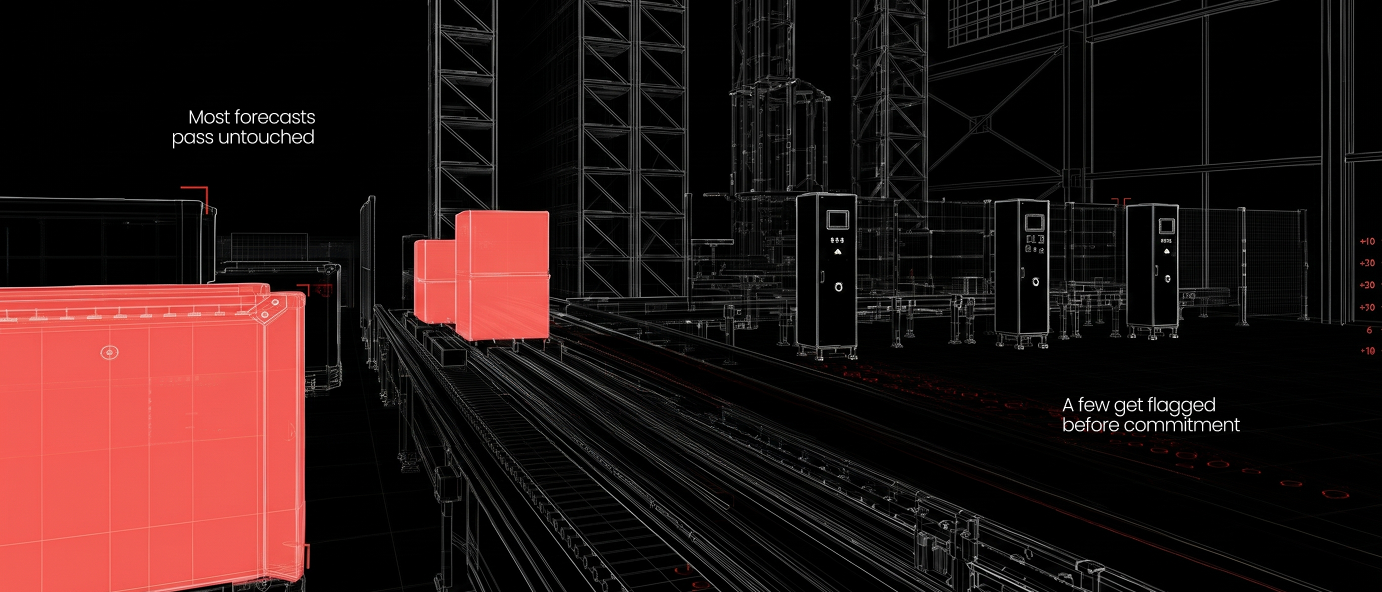
Ordinary forecasts flow through untouched, which preserves the efficiency the model provides across the great majority of periods.
Forecasts produced in conditions the model has not seen are flagged before the number reaches procurement and production. Those are the cases that go to scenario planning, to a more conservative commitment, or to a planner who can weigh what the model cannot. The judgment being applied is human, and it is now being applied to the handful of forecasts that need it rather than to all of them or to none.
A team also gains a record of how often the model was operating outside its experience. That count is a better measure of forecasting risk than accuracy over the same period, because accuracy is dominated by the ordinary weeks.
.png)
What a flag does not supply
Mapping the decision space identifies forecasts made in conditions unlike the model's training history. It does not predict what demand will actually do in those conditions, and no method can. The flag says the model has no basis for this forecast rather than supplying a better one.
The approach also depends on how the forecasting model is built. The method works by clustering the internal representations a neural network produces, so it applies to a neural forecasting model and not to a classical statistical one, which has no equivalent internal state to examine.
And holding forecasts back has a cost. Every flagged period consumes planner attention, so where the boundary is drawn is a trade-off between caution and the throughput that made automated forecasting worthwhile.
Trust that matches footing
A demand forecast earns trust by being right through every ordinary condition a business faces. That track record is what makes it dangerous in an extraordinary one, because trust earned in familiar conditions carries over unexamined into conditions where it no longer applies.
Giving the forecast a way to signal when it has left the world it learned turns its confidence into something meaningful. High where the model has real footing, and withheld where it does not. For an operation committing capital and capacity to a number weeks before demand arrives, knowing which forecasts to distrust is worth more than a forecast that is confident about everything.
A representative scenario, grounded in published work on demand forecasting and the bullwhip effect. Vision Studio's capabilities are described as designed rather than measured from a deployment.