Cognitive AI is The Next Scientific Frontier in Machine Intelligence
From Explainability
to Cognition
The first generation of modern AI, statistical AI, focused on optimizing performance through scale: more parameters, more data, deeper networks. The second generation, explainable AI (XAI), sought to interpret model outputs, using saliency maps, feature attributions, and slice discovery to reveal how models behave. While valuable, these approaches remain diagnostic. They help humans analyze errors after the fact, but do not change how models make decisions.
Cognitive AI represents a third generation. It embeds reasoning within the system itself, enabling models to:
Map
the geometry of success and failure in training data.
DETECT
when an input falls into regions of ambiguity or uncertainty.
TRIGGER
adaptive interventions when predictions are unreliable.
Rather than functioning as a black box with a static confidence threshold, Cognitive AI actively monitors its own decision-making and adjusts dynamically. It operationalizes explainability into an ongoing cognitive process.
From Explainability
to Cognition
The first generation of modern AI, statistical AI, focused on optimizing performance through scale: more parameters, more data, deeper networks. The second generation, explainable AI (XAI), sought to interpret model outputs, using saliency maps, feature attributions, and slice discovery to reveal how models behave. While valuable, these approaches remain diagnostic. They help humans analyze errors after the fact, but do not change how models make decisions.
Cognitive AI represents a third generation. It embeds reasoning within the system itself, enabling models to:
Map
the geometry of success and failure in training data.
DETECT
when an input falls into regions of ambiguity or uncertainty.
TRIGGER
adaptive interventions when predictions are unreliable.
Rather than functioning as a black box with a static confidence threshold, Cognitive AI actively monitors its own decision-making and adjusts dynamically. It operationalizes explainability into an ongoing cognitive process.
For much of its modern history, artificial intelligence has advanced through accumulation. More data, more parameters, more compute. This strategy has delivered undeniable gains, pushing models to levels of performance that once seemed unattainable. In many domains, data has been the fuel that unlocked capability.
But data-driven progress is approaching a fundamental limit.
As AI systems move from controlled benchmarks into real-world environments, the marginal returns of additional data diminish while the cost of failure grows. Models trained on ever-larger datasets still break under modest shifts, still act with misplaced confidence, and still struggle in situations that demand judgment rather than pattern recall.
What More Data Actually Fixes, and What It Doesn’t
Additional data improves coverage within the space of previously observed patterns. It fills gaps between known examples, smooths decision boundaries, and reduces variance in familiar regions. These benefits are real, and they explain why scale has been so effective historically.
What data does not provide is awareness.
No amount of data teaches a model:
- When it is extrapolating rather than interpolating
- When internal representations are unstable
- When ambiguity dominates a decision
- When assumptions learned from the past no longer apply
Data improves what a model knows. It does not improve the model’s ability to know what it does not know.
The Combinatorial Wall of the Real World
The belief that more data will eventually solve AI’s reliability problem rests on a flawed assumption: that the real world can be sufficiently sampled.
In practice, real-world environments exhibit combinatorial complexity. Ordinary situations arise from the interaction of many factors:
- Lighting, weather, and sensor state
- Human behavior and demographics
- Temporal context and system state
- Policy, protocol, and process changes
Each factor adds degrees of freedom. Together, they create an explosion of plausible conditions that no dataset can exhaustively cover. Even if each factor is individually well-represented, their combinations are not.
Why Data Cannot Teach Judgment
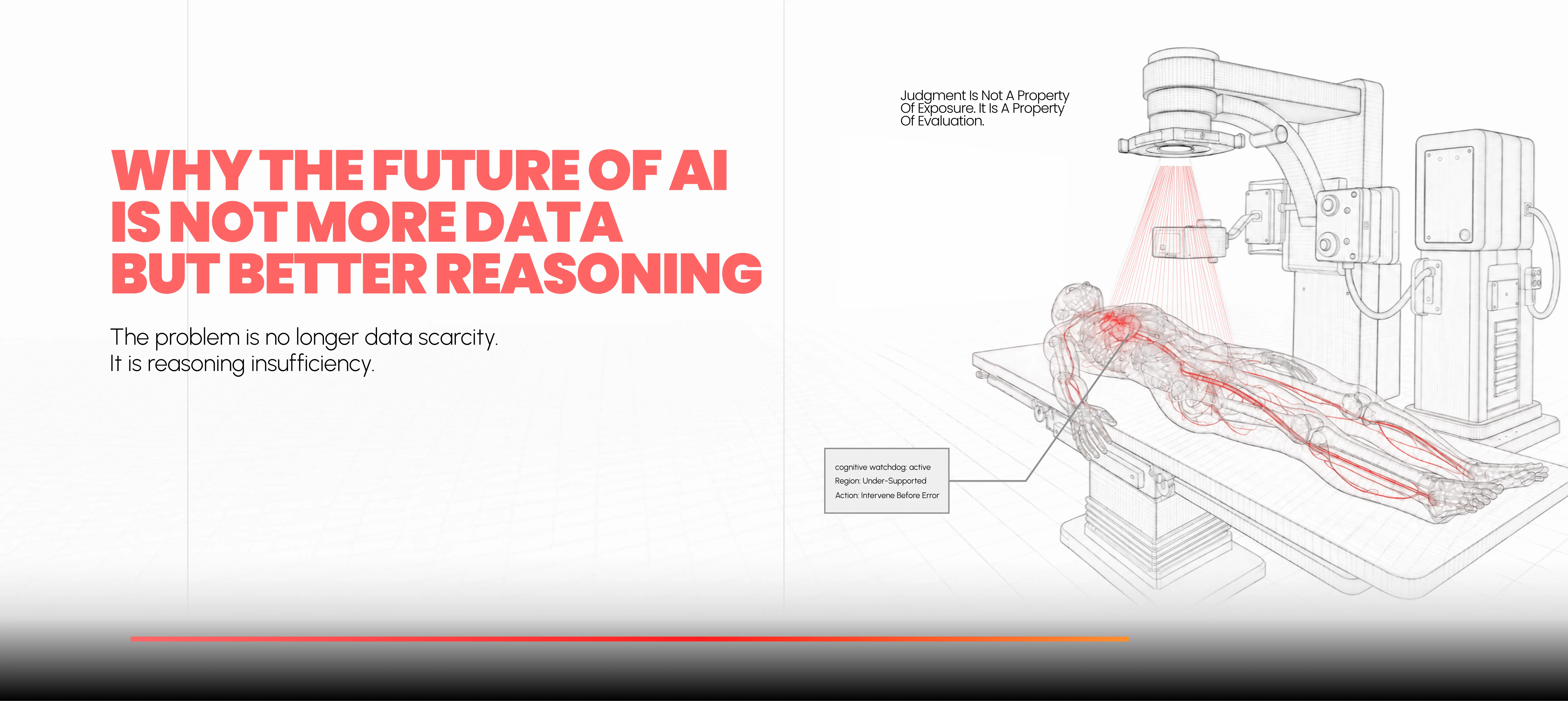
Judgment is not a property of exposure. It is a property of evaluation.
Humans do not become better decision-makers solely by seeing more examples. They become better by learning:
- Which contexts are familiar
- Which are ambiguous
- Which are risky
- How to adapt behavior accordingly
AI systems trained purely on data lack this meta-level reasoning. They are optimized to minimize average error, not to regulate behavior under uncertainty. When faced with unfamiliar or ambiguous situations, they do not hesitate. They interpolate aggressively and commit. This is why AI systems often appear most confident precisely when they should be cautious.
The Data Fallacy in High-Stakes Domains
In high-stakes settings, the limits of data-centric thinking become especially clear. In healthcare, rare but clinically significant cases remain underrepresented no matter how large the dataset grows. In autonomous driving, new combinations of ordinary conditions appear daily. In finance, market regimes shift in ways that historical data cannot fully anticipate.
In each case, failures do not occur because the system lacked examples. They occur because the system lacked the ability to reason about insufficiency.
Adding more data after the fact may reduce similar failures in the future, but it does nothing to prevent the next, different one.
Why Reasoning Is the Bottleneck
Reasoning, in the context of AI, does not mean symbolic logic or human-like thought. It means something more fundamental:
- The ability to assess the reliability of one’s own internal representations.
- The ability to distinguish between certainty and ambiguity.
- The ability to adapt behavior when confidence is unwarranted.
These capabilities are not learned automatically from data. They require architectural support. They require systems that monitor their own internal state and act on that information.
Without reasoning, data-driven systems remain reactive. They learn only after failure.
From Learning More to Knowing When to Stop
One of the most important forms of intelligence is restraint. A system that always acts is not intelligent; it is impulsive. Intelligence emerges when a system knows when to slow down, defer, or refuse to act because conditions are unclear.
This capacity cannot be learned from labels alone. It requires:
- Awareness of context
- Recognition of uncertainty
- Control over action
In other words, it requires cognition.
How Cognitive AI Reframes Progress
Cognitive AI shifts the axis of progress from quantity to quality from more examples to better judgment.
Instead of assuming that every input is sufficiently modeled, a cognitive system asks:
- Where does this input fall within my learned experience?
- How dense or sparse is the surrounding support?
- Have similar internal states led to failure before?
- Should I adapt my behavior in response?
This reasoning happens in real time, before decisions are executed. The system no longer treats uncertainty as an afterthought. It treats it as a governing signal.
The Role of SQUINT Cognition
SQUINT Cognition exists to make this shift operational.
Rather than collecting more data in the hope of covering every possibility, SQUINT maps the internal representation space of models, identifying where behavior is reliable, where it is ambiguous, and where it is historically fragile.
Runtime cognitive watchdogs monitor how new inputs move through this space. When the system begins to operate in under-supported or risky regions, SQUINT intervenes, adjusting behavior before errors occur.
The result is not a model that knows everything, but a system that knows when knowing less should change how it acts.
Why This Is the Next Phase of AI Progress
The history of AI has been shaped by data because data was the primary constraint. Today, that constraint is shifting. The hardest problems are no longer about recognition or recall. They are about reliability under uncertainty.
Progress will come not from feeding models more examples of the past, but from equipping them to reason about the present.
The future of AI will belong to systems that:
- Understand context
- Recognize uncertainty
- Adapt behavior
- Regulate themselves in real time