Cognitive AI is The Next Scientific Frontier in Machine Intelligence
From Explainability to Cognition
The first generation of modern AI, statistical AI, focused on optimizing performance through scale: more parameters, more data, deeper networks. The second generation, explainable AI (XAI), sought to interpret model outputs, using saliency maps, feature attributions, and slice discovery to reveal how models behave. While valuable, these approaches remain diagnostic. They help humans analyze errors after the fact, but do not change how models make decisions.
Cognitive AI represents a third generation. It embeds reasoning within the system itself, enabling models to:
Map
the geometry of success and failure in training data.
DETECT
when an input falls into regions of ambiguity or uncertainty.
TRIGGER
adaptive interventions when predictions are unreliable.
Rather than functioning as a black box with a static confidence threshold, Cognitive AI actively monitors its own decision-making and adjusts dynamically. It operationalizes explainability into an ongoing cognitive process.
From Explainability to Cognition
The first generation of modern AI, statistical AI, focused on optimizing performance through scale: more parameters, more data, deeper networks. The second generation, explainable AI (XAI), sought to interpret model outputs, using saliency maps, feature attributions, and slice discovery to reveal how models behave. While valuable, these approaches remain diagnostic. They help humans analyze errors after the fact, but do not change how models make decisions.
Cognitive AI represents a third generation. It embeds reasoning within the system itself, enabling models to:
Map
the geometry of success and failure in training data.
DETECT
when an input falls into regions of ambiguity or uncertainty.
TRIGGER
adaptive interventions when predictions are unreliable.
Rather than functioning as a black box with a static confidence threshold, Cognitive AI actively monitors its own decision-making and adjusts dynamically. It operationalizes explainability into an ongoing cognitive process.
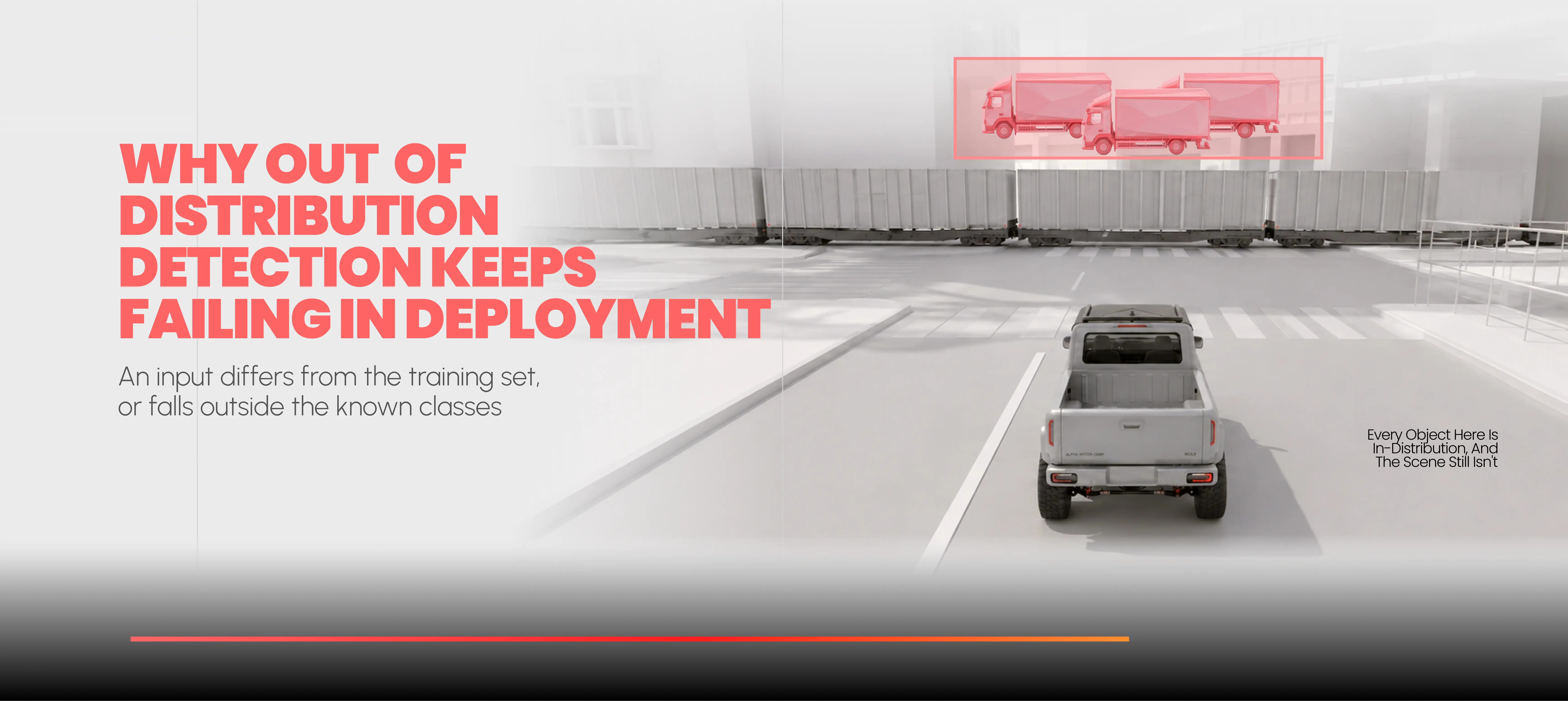
Out-of-distribution detection usually gets framed as a data question.
An input differs from the training set, or falls outside the known classes, or covers a case nobody anticipated. Most detection methods follow from that framing and watch surface signals: confidence scores, likelihood estimates, reconstruction error, disagreement between classifiers.
After years of research, these methods remain unreliable in practice. Models still misclassify unfamiliar inputs with high confidence, still fail to flag genuinely new situations, and still break in deployment without any warning.
The shortfall has little to do with algorithm design. The problem has been framed in the wrong place. Novelty shows up inside the model, in the space where inputs become representations, rather than at the input itself.
Why the usual framing does not hold
Most pipelines treat this as a yes or no question. An input is either in distribution or out of it. That assumes distributions are well defined, cleanly separable, and stable over time.
Deployed systems rarely offer any of those things. Environments change. New conditions appear gradually rather than all at once. Inputs are seldom completely alien, and are more often familiar elements arriving in an unfamiliar combination. From the model's point of view, novelty arrives as a gradient rather than a line. Forcing that gradient into a binary decision throws away the structure that would have been useful.
Where novelty actually shows up
Every modern model maps its inputs into an internal representation space. That space encodes similarity and context, and it is where decisions take shape. Different parts of that space mean different things. Dense regions hold experience the model has plenty of. Sparse regions mean the model is extrapolating. Overlapping regions mean two or more answers fit. Distant regions mean the input has little in common with anything the model learned.
So being out of distribution is a position rather than a label. It describes where a representation landed.
The questions worth asking
Framed this way, detection comes down to a few things you can actually measure.
How far is this representation from regions the model knows well? How crowded is the neighbourhood around it? Does it sit inside a cluster where the model has been reliable, or near a boundary where it has made errors before? Has it drifted over time away from regions that used to be stable?
These are properties of the representation space itself. They are not properties of individual input features or output probabilities. A model does not fail because an input looks strange. It fails because the representation of that input lands somewhere the model has little to stand on.
Why confidence scores do not work
Confidence is the most common signal used for this. If the model seems uncertain, the input gets treated as unfamiliar.
The logic breaks down on inspection. A softmax confidence score measures how strongly the model prefers one known class over the others. It says nothing about whether any of those classes fit. A model can report high confidence precisely because it has forced an unfamiliar input into the nearest known category, even when that category is a poor match.
Confidence answers which class the model prefers. Detecting novelty requires knowing whether that preference deserves any weight at all. Those are separate questions, and one does not answer the other.
Why likelihood estimates do not work either
Another approach assigns a likelihood to each input and treats low likelihood as novelty.
In high-dimensional spaces, likelihood behaves in ways that defeat this. Models frequently assign higher likelihood to unfamiliar inputs than to familiar ones, particularly when those inputs happen to exploit quirks in how density gets estimated.
That behaviour follows from the geometry. Likelihood sums across all dimensions, while novelty often shows up in direction rather than magnitude. Two representations can carry similar likelihood while sitting in very different parts of the space.
Why reconstruction error falls short
Autoencoder methods assume an unfamiliar input will reconstruct badly. In practice autoencoders generalise too well. They reconstruct a novel input by projecting it onto a familiar shape.
The reconstruction comes out looking plausible and the error stays small. The novelty gets absorbed rather than revealed. Here again the useful signal is where the representation sits, not how large the error is.
Novelty as a gradient
The practical consequence of all this is that novelty is not a rare event to be caught. It is a continuous drift.
Inputs move gradually from dense regions toward sparse ones, from stable representations toward ambiguous ones, from reasoning the model can support toward reasoning it cannot. Systems that wait for a binary threshold miss the chance to respond while the drift is still small.
Detection on its own is not much use
Even when a system correctly identifies an unfamiliar input, most stop at that point. They raise a flag, write a log entry, or reject the input outright.
For anything high-stakes that is not enough. The useful question is not whether an input is unfamiliar, but how the system should behave given where that input has landed. Unfamiliarity does not always call for rejection. Sometimes it calls for caution, sometimes for escalation, sometimes for adapting the way the system operates. Detection without a matching response is a warning nobody acts on.
What a geometric approach makes possible
Treating this as a question about representation space changes what a system can do.
Rather than watching for novelty at the output, the model's internal space gets mapped during development. Regions of reliability, ambiguity, and past failure are identified. At runtime, the system tracks how representations move through that space.
Novelty then becomes something measurable rather than exceptional, which lets a system reason about how risky a given input is and what to do about it.
How Squint Cognition approaches it
Squint treats this as a geometric problem from the start. During development, Squint analyses a model's internal representations to estimate density and support, identify boundaries and overlaps, and correlate regions with where the model has succeeded and failed. The result is a reliability map of the model's internal space.
In deployment, cognitive watchdogs check where each new input lands on that map. When representations drift toward sparse, ambiguous, or historically fragile regions, the watchdog acts before the system commits to a decision. What it does depends on the situation. It can escalate to a more capable model, hand the case to a person, adjust operating parameters, or move the system into a minimal-risk mode.
Why this matters in deployed systems
In autonomous vehicles, healthcare diagnostics, and financial decision systems, unfamiliar inputs are unavoidable. The world moves, contexts shift, and new combinations keep appearing.
Systems that treat this as an afterthought stay brittle. Systems that understand where their representations sit can respond. What separates them is less about detection accuracy than about knowing their own position.
Why this matters in deployed systems
In autonomous vehicles, healthcare diagnostics, and financial decision systems, unfamiliar inputs are unavoidable. The world moves, contexts shift, and new combinations keep appearing.
Systems that treat this as an afterthought stay brittle. Systems that understand where their representations sit can respond. What separates them is less about detection accuracy than about knowing their own position.
Closing thought
Out-of-distribution detection has struggled because it has been treated as a surface problem. The signal that matters sits deeper, in the structure of the representation space.
Knowing where a system is in that space, and how that position relates to risk, is what makes a system trustworthy in the field. Squint Cognition exists to make that structure visible and usable, so that novelty becomes a condition a system can reason about rather than an error it merely reports.