

Cognitive AI is The Next Scientific Frontier in Machine Intelligence
From Explainability
to Cognition
The first generation of modern AI, statistical AI, focused on optimizing performance through scale: more parameters, more data, deeper networks. The second generation, explainable AI (XAI), sought to interpret model outputs, using saliency maps, feature attributions, and slice discovery to reveal how models behave. While valuable, these approaches remain diagnostic. They help humans analyze errors after the fact, but do not change how models make decisions.
Cognitive AI represents a third generation. It embeds reasoning within the system itself, enabling models to:
Map
the geometry of success and failure in training data.
DETECT
when an input falls into regions of ambiguity or uncertainty.
TRIGGER
adaptive interventions when predictions are unreliable.
Rather than functioning as a black box with a static confidence threshold, Cognitive AI actively monitors its own decision-making and adjusts dynamically. It operationalizes explainability into an ongoing cognitive process.
From Explainability
to Cognition
The first generation of modern AI, statistical AI, focused on optimizing performance through scale: more parameters, more data, deeper networks. The second generation, explainable AI (XAI), sought to interpret model outputs, using saliency maps, feature attributions, and slice discovery to reveal how models behave. While valuable, these approaches remain diagnostic. They help humans analyze errors after the fact, but do not change how models make decisions.
Cognitive AI represents a third generation. It embeds reasoning within the system itself, enabling models to:
Map
the geometry of success and failure in training data.
DETECT
when an input falls into regions of ambiguity or uncertainty.
TRIGGER
adaptive interventions when predictions are unreliable.
Rather than functioning as a black box with a static confidence threshold, Cognitive AI actively monitors its own decision-making and adjusts dynamically. It operationalizes explainability into an ongoing cognitive process.
When AI systems behave unpredictably, one of the first controls engineers reach for is a confidence threshold. If the model is “confident enough,” allow the decision. If confidence falls below a predefined cutoff, defer, escalate, or abstain.
At first glance, this seems sensible. Confidence appears to offer a simple proxy for trust. Confidence thresholds are one of the most persistent and misleading control mechanisms in modern AI systems.
They fail because confidence is the wrong signal.
The Appeal of Confidence Thresholds
Confidence thresholds are attractive for three reasons:
1. They are easy to implement
Most models already output probabilities. Adding a cutoff requires minimal engineering.
2. They are intuitive to humans
We naturally associate confidence with certainty. Low confidence feels like a reason to pause.
3. They appear to reduce risk
In controlled settings, filtering low-confidence predictions often improves average accuracy.
These advantages explain why confidence thresholds are widely used in healthcare triage systems, autonomous driving pipelines, financial decision engines, and content moderation platforms.
They also explain why their limitations are so dangerous.
What Confidence Actually Measures
In most AI systems, confidence is derived from a softmax function applied to logits, the raw scores produced by the model’s final layer.
Technically, softmax answers a narrow question:
Which option does the model prefer most among the available choices?
It does not answer:
- Whether the input is familiar
- Whether the internal representation is stable
- Whether the model is extrapolating
- Whether similar cases have failed before
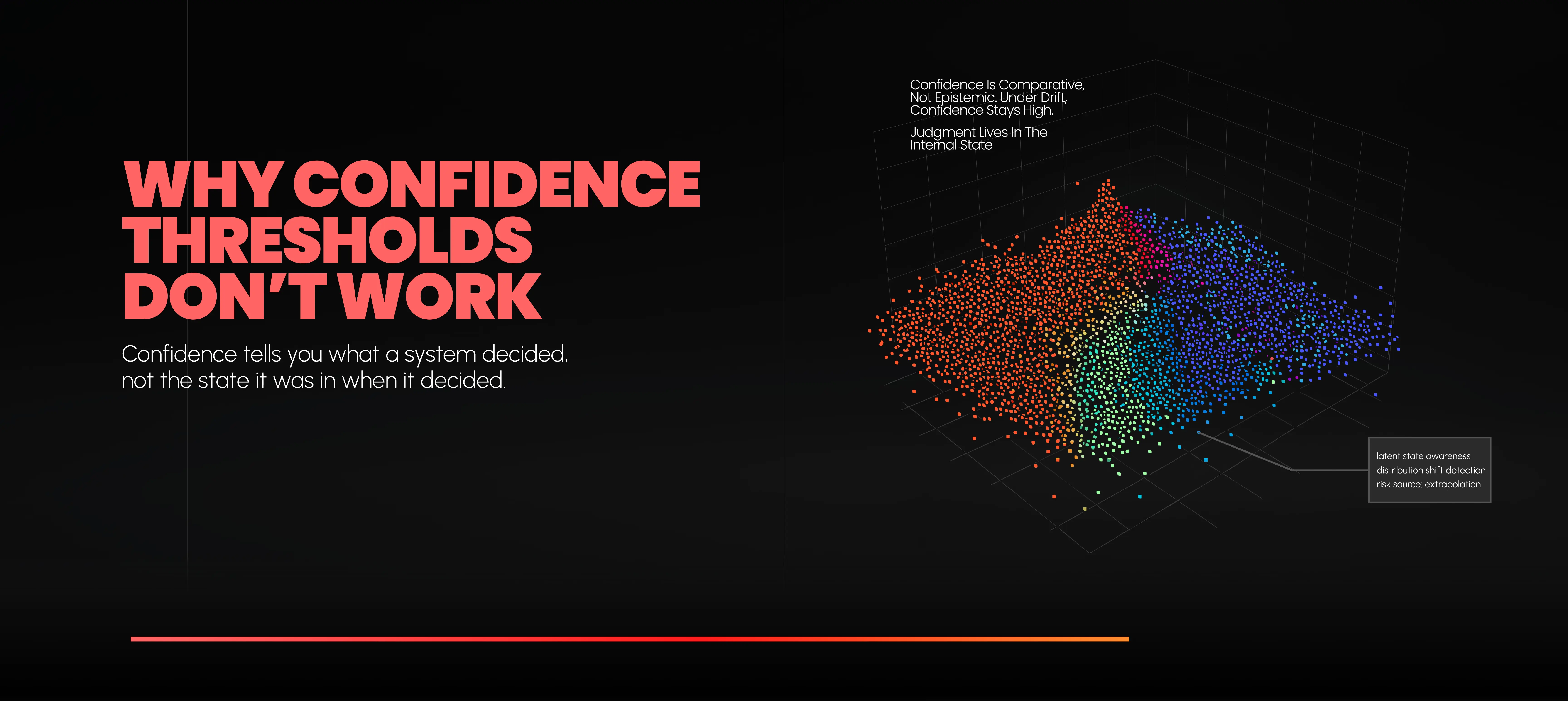
Softmax confidence is comparative, not epistemic. It expresses relative preference, not reliability. As a result, confidence thresholds are built on a signal that was never designed to govern behavior.
The High-Confidence Error Problem
The most damaging failures in AI systems are rarely low-confidence mistakes. They are high-confidence errors.
Examples abound:
- A medical diagnosis marked “benign” with 97% confidence.
- An autonomous system asserting “clear path” moments before intervention.
- A trading model issuing a strong signal during a regime shift.
- A language model fabricating facts with absolute certainty.
In each case, a confidence threshold would not have intervened. The model met the threshold precisely because it was confidently wrong.
Why Thresholds Fail Under Distribution Shift
Confidence thresholds implicitly assume that confidence behaves consistently across contexts. That assumption holds only when deployment data closely matches training data. Under distribution shift: new sensors, populations, and environments, this assumption breaks down.
As inputs drift, internal representations move into sparse or unstable regions, but confidence often remains high because the model is forced to choose among known classes. Thresholds remain blind to this drift. They gate decisions based on a scalar that does not reflect internal instability.
This is why systems appear stable until they suddenly are not.
The False Precision of Threshold Tuning
When confidence thresholds fail, the usual response is to tune them.
Engineers adjust cutoffs:
- Raising thresholds to be more conservative
- Lowering them to reduce abstentions
- Calibrating probabilities on validation sets
This creates an illusion of control.
Threshold tuning optimizes behavior on known data. It does nothing to address:
- Unknown contexts
- Emergent failure modes
- Latent drift
- Shortcut-driven reasoning
A threshold that works today becomes brittle tomorrow.
Why Confidence Thresholds Collapse Ambiguity
Confidence thresholds treat uncertainty as a scalar, but uncertainty in AI systems is structural, not one-dimensional.
Ambiguity arises from:
- Overlapping class representations
- Conflicting signals across modalities
- Sparse support in latent space
- Temporal instability
These conditions cannot be summarized by a single number.
By collapsing uncertainty into a threshold, systems lose the ability to distinguish between:
- Benign ambiguity and dangerous extrapolation
- Familiar uncertainty and novel uncertainty
- Recoverable risk and systemic fragility
The result is coarse control applied to a fine-grained problem.
Thresholds Are Reactive
Perhaps most critically, confidence thresholds operate at the output level. They act only after the model has produced a prediction.
By the time confidence is evaluated:
- The internal reasoning has already occurred.
- The representation has already formed.
- The opportunity to intervene early has passed.
Thresholds can block decisions, but cannot anticipate failure. In high-stakes systems, this distinction is crucial. Safety requires intervention before an incorrect action is committed.
Why Thresholds Persist Despite Their Failures
Confidence thresholds persist because they offer a comforting simplification. They suggest that reliability can be managed with a single parameter.
In reality, reliability is contextual. It depends on:
- Where a representation lies in latent space
- How dense or sparse that region is
- How similar it is to known failure modes
- How internal states evolve over time
Thresholds ignore all of this complexity. They fail silently until a system encounters a case that matters.
From Confidence to Contextual Judgment
Replacing confidence thresholds does not mean eliminating confidence. It means decoupling trust from probability.
A system capable of judgment evaluates:
- Internal representation geometry
- Proximity to reliable or fragile regions
- Historical outcomes associated with similar states
- Contextual signals that indicate risk
Judgment is multi-dimensional. It cannot be reduced to a scalar cutoff.
How SQUINT Cognition Replaces Thresholds
SQUINT Cognition abandons confidence thresholds as the primary control mechanism.
Instead, it monitors the internal state of the model:
- Where each input lands in latent space
- How dense the surrounding region is
- Whether the representation resembles known failure clusters
- Whether drift or instability is emerging
When risk is detected, SQUINT intervenes before the system commits to action. The response is contextual:
- Escalate to a more robust model
- Defer to human judgment
- Alter operational parameters
- Enter a minimal-risk mode