

Cognitive AI is The Next Scientific Frontier in Machine Intelligence
From Explainability
to Cognition
The first generation of modern AI, statistical AI, focused on optimizing performance through scale: more parameters, more data, deeper networks. The second generation, explainable AI (XAI), sought to interpret model outputs, using saliency maps, feature attributions, and slice discovery to reveal how models behave. While valuable, these approaches remain diagnostic. They help humans analyze errors after the fact, but do not change how models make decisions.
Cognitive AI represents a third generation. It embeds reasoning within the system itself, enabling models to:
Map
the geometry of success and failure in training data.
DETECT
when an input falls into regions of ambiguity or uncertainty.
TRIGGER
adaptive interventions when predictions are unreliable.
Rather than functioning as a black box with a static confidence threshold, Cognitive AI actively monitors its own decision-making and adjusts dynamically. It operationalizes explainability into an ongoing cognitive process.
From Explainability
to Cognition
The first generation of modern AI, statistical AI, focused on optimizing performance through scale: more parameters, more data, deeper networks. The second generation, explainable AI (XAI), sought to interpret model outputs, using saliency maps, feature attributions, and slice discovery to reveal how models behave. While valuable, these approaches remain diagnostic. They help humans analyze errors after the fact, but do not change how models make decisions.
Cognitive AI represents a third generation. It embeds reasoning within the system itself, enabling models to:
Map
the geometry of success and failure in training data.
DETECT
when an input falls into regions of ambiguity or uncertainty.
TRIGGER
adaptive interventions when predictions are unreliable.
Rather than functioning as a black box with a static confidence threshold, Cognitive AI actively monitors its own decision-making and adjusts dynamically. It operationalizes explainability into an ongoing cognitive process.
Autonomy is often described as the pinnacle of artificial intelligence: systems that act independently, make decisions at speed, and operate without constant human oversight. From self-driving vehicles to automated medical diagnostics and algorithmic trading systems, autonomy promises efficiency, scalability, and performance beyond human limits.
Yet autonomy alone is not intelligence. And autonomy without cognition is not just incomplete, it is unsafe.
The current generation of autonomous systems is built on models that predict outcomes but do not reason about the conditions under which those predictions remain valid. They act decisively, but without an internal understanding of uncertainty, context, or limitation. In controlled environments this can appear sufficient. In real-world settings, where complexity, ambiguity, and change are the norm, it becomes a structural liability.
The Misconception at the Core of Autonomous AI
Most autonomous systems today are the result of a straightforward assumption: if a model is accurate enough, fast enough, and trained on sufficient data, it can be trusted to act on its own.
This assumption conflates
performance with judgment.
A model may correctly classify objects, estimate probabilities, or optimize a reward function, but none of these imply that it understands when its outputs should be trusted. Autonomy built on prediction alone assumes that the world encountered in deployment will resemble the world encoded in training. That assumption rarely holds.
In practice, autonomous systems encounter:
- Novel combinations of inputs
- Shifting environments
- Edge cases that were underrepresented or absent in training data.
- Degraded sensors
- Ambiguous or conflicting signals
Without cognition, the system cannot recognize these conditions as risky. It continues to act as if all contexts are equally well understood.
What Cognition Adds That Autonomy Lacks
In humans, autonomy is always paired with cognition. We do not act solely on pattern recognition. We continuously evaluate context, assess uncertainty, and adapt our behavior when conditions change. We hesitate, seek confirmation, or defer action altogether when confidence is unwarranted.
Cognition, in this sense, is not
intelligence as output quality, it is
intelligence as self-regulation.
For an AI system, cognition requires three capabilities that most autonomous systems do not possess:
1. Contextual Awareness
The ability to situate a decision within the broader landscape of prior experience and current conditions.
2. Uncertainty recognition
The ability to distinguish between reliable predictions, ambiguous cases, and situations where the system is extrapolating beyond its knowledge.
3. Adaptive control
The ability to modify behavior: slow down, escalate, defer, or change strategy, based on internal assessments of risk.
Autonomy without these capabilities is blind autonomy.
Why Autonomous Systems Fail in Practice
The failure modes of autonomous systems are well documented, and they share a common structure.
High-confidence errors
Autonomous systems frequently commit errors with extreme confidence. This occurs because confidence scores reflect numerical dominance, not epistemic certainty. The system does not know when its internal representation is unstable or poorly supported by training data.
Inability to recognize novelty
Autonomous systems extrapolate when encountering unfamiliar inputs. They do not recognize novelty as novelty; they simply map it to the closest known pattern and proceed.
Silent degradation
As environments change: weather, lighting, populations, market regimes, model performance degrades gradually. Without internal monitoring of representation drift, the system provides no warning that reliability is eroding.
No mechanism for hesitation
Perhaps most critically, autonomous systems lack the ability to pause. They must always act. In ambiguous conditions where a human would slow down or seek help, the system continues forward with full authority.
These failures are not the result of poor engineering. They are the direct consequence of architectures that treat autonomy as execution, not as judgment.
The Structural Gap: Action Without Self-Assessment
Technically, most autonomous systems operate as follows:
1. Inputs are transformed into latent representations.
2. Those representations are mapped to actions or decisions.
3. The system executes the action immediately.
At no point does the system ask:
- Is this representation similar to ones I’ve failed on before?
- Am I operating in a region of low support or high ambiguity?
- Have my internal assumptions drifted from reality?
The internal state that governs reliability, the geometry of the latent representation, is invisible to the decision-making loop. As a result, autonomy is exercised without introspection.
This is why autonomous systems
often fail abruptly and inexplicably:
they have no internal signal
that distinguishes safe action
from unsafe action.
Why Safety Cannot Be Bolted On After the Fact
Many attempts to address the risks of autonomy rely on external controls:
- Hard-coded rules
- Monitoring dashboards
- Static thresholds
- Post-hoc audits
These approaches operate outside the decision process. They observe outcomes, not reasoning. They cannot intervene at the moment where failure becomes likely.
True safety in autonomous systems must be intrinsic. It must arise from the system’s ability to evaluate its own internal state before an action is taken.
This is the role of cognition.
Cognition as the Foundation of Safe Autonomy
A cognitively aware autonomous system behaves differently from a purely predictive one.
Instead of asking only “What action maximizes my objective?” it also asks:
- “How confident should I be in this action, given my internal understanding?”
- “Does this situation resemble contexts where I have historically failed?”
- “Should I adapt my behavior or defer control?”
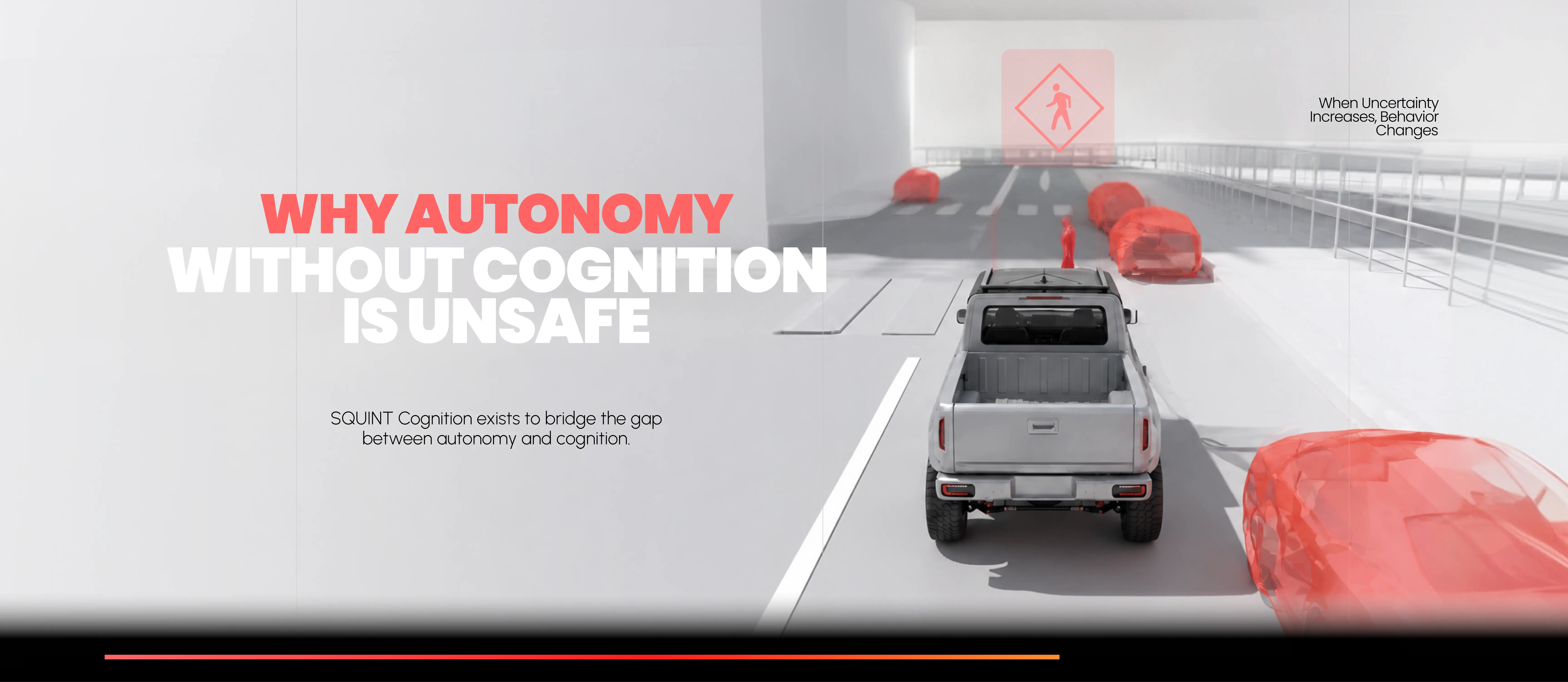
When uncertainty increases, behavior changes:
- Speed is reduced
- Additional information is sought
- Decisions are escalated
- Control is safely relinquished