

Cognitive AI is The Next Scientific Frontier in Machine Intelligence
From Explainability
to Cognition
The first generation of modern AI, statistical AI, focused on optimizing performance through scale: more parameters, more data, deeper networks. The second generation, explainable AI (XAI), sought to interpret model outputs, using saliency maps, feature attributions, and slice discovery to reveal how models behave. While valuable, these approaches remain diagnostic. They help humans analyze errors after the fact, but do not change how models make decisions.
Cognitive AI represents a third generation. It embeds reasoning within the system itself, enabling models to:
Map
the geometry of success and failure in training data.
DETECT
when an input falls into regions of ambiguity or uncertainty.
TRIGGER
adaptive interventions when predictions are unreliable.
Rather than functioning as a black box with a static confidence threshold, Cognitive AI actively monitors its own decision-making and adjusts dynamically. It operationalizes explainability into an ongoing cognitive process.
From Explainability
to Cognition
The first generation of modern AI, statistical AI, focused on optimizing performance through scale: more parameters, more data, deeper networks. The second generation, explainable AI (XAI), sought to interpret model outputs, using saliency maps, feature attributions, and slice discovery to reveal how models behave. While valuable, these approaches remain diagnostic. They help humans analyze errors after the fact, but do not change how models make decisions.
Cognitive AI represents a third generation. It embeds reasoning within the system itself, enabling models to:
Map
the geometry of success and failure in training data.
DETECT
when an input falls into regions of ambiguity or uncertainty.
TRIGGER
adaptive interventions when predictions are unreliable.
Rather than functioning as a black box with a static confidence threshold, Cognitive AI actively monitors its own decision-making and adjusts dynamically. It operationalizes explainability into an ongoing cognitive process.
Edge Cases Are Not Rare, They Are Structurally
Under-Modeled
When AI systems fail, the failures are often described as “edge cases.” The phrase suggests rarity: unusual inputs, extreme conditions, or unlikely combinations of events that sit at the periphery of normal operation. The implication is comforting, if edge cases are rare, then failures are acceptable anomalies rather than fundamental flaws.
This framing is deeply misleading.
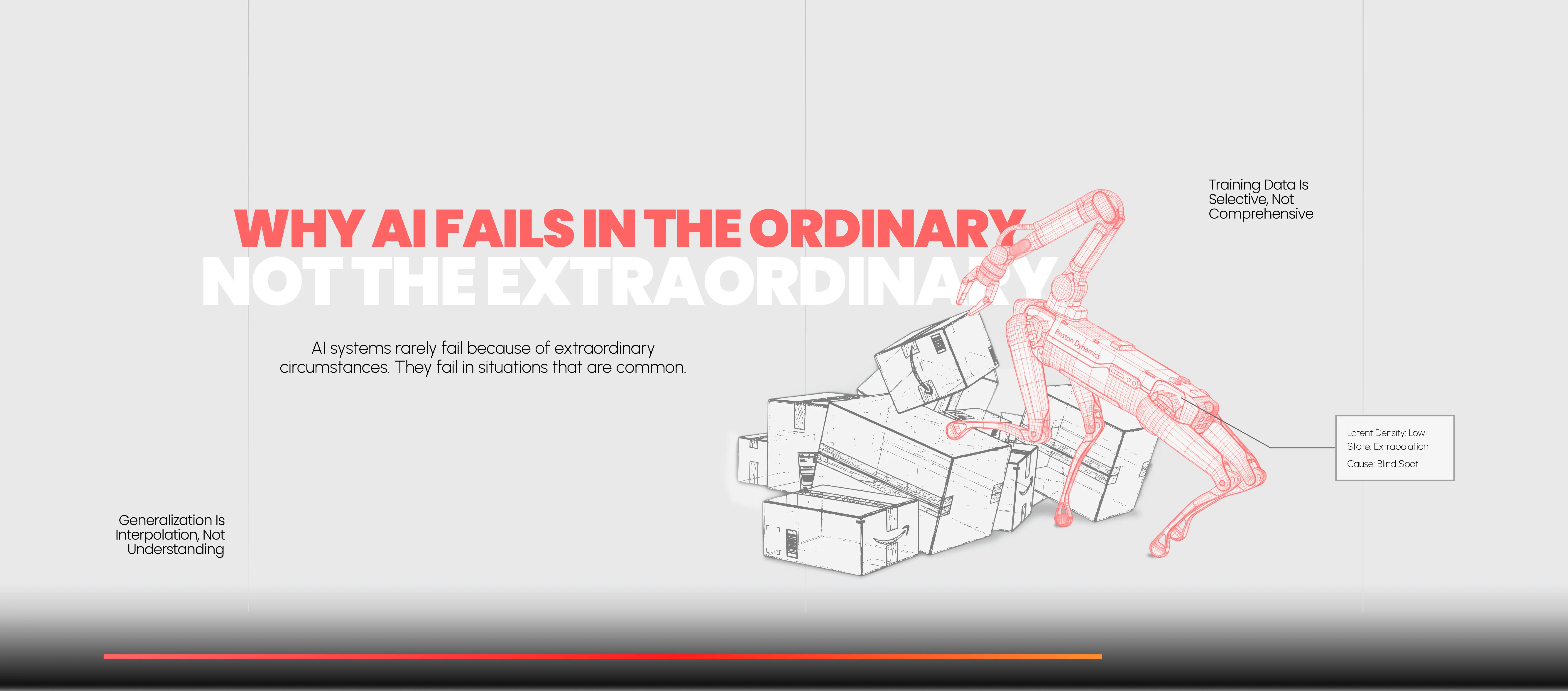
In practice, AI systems rarely fail because of extraordinary circumstances. They fail in situations that are common, mundane, and entirely predictable once the system is deployed in the real world. Slightly different lighting. Mild sensor degradation. A patient who does not match the dominant demographic in the training set. A market behaving normally, but differently than it did historically.
These are not edge cases.
They are the ordinary reality that machine learning systems are structurally ill-equipped to handle.
The Myth of the
Edge Case
In traditional software engineering, edge cases truly are rare. They arise from unanticipated logical combinations: division by zero, overflow conditions, and invalid inputs. Once discovered, they can usually be fixed explicitly.
Machine learning systems operate
under a different regime.
They do not encode logic. They encode statistical regularities learned from data. What they model well is not what is common in the world, but what is densely represented in the training distribution. Everything else, no matter how common in reality, becomes under-modeled.
From the model’s perspective, an “edge case” is not defined by rarity in the world, but by distance from dense regions of its learned representation space.
Why Ordinary Situations
Become “Edge Cases” to AI
1. Training Data Is Selective, Not Comprehensive
No dataset captures the full entropy of the real world. Data collection is constrained by cost, access, labeling effort, and historical bias. As a result, training datasets tend to overrepresent:
- Ideal conditions
- Majority populations
- Common sensor configurations
- Standard protocols
- Well-lit scenes
What appears “ordinary” to humans may be sparsely represented or entirely absent, in training data.
A pedestrian in partial shadow is ordinary.
A patient with atypical symptoms is ordinary.
A market operating under a new but reasonable regime is ordinary.
To the model, these inputs are marginal.
2. Learning Optimizes for Density, Not Coverage
Deep learning models are optimized to minimize average loss. This encourages them to allocate representational capacity where data is dense and performance gains are easiest.
Technically, this means:
- Dense regions of latent space are modeled smoothly
- Sparse regions are approximated poorly
- Decision boundaries are shaped by dominant patterns
The model does not “know” that sparse regions matter. It simply learns that investing capacity there yields minimal improvement on the training objective.
As a result,
ordinary but underrepresented
cases become structurally fragile.
3. Generalization Is Interpolation, Not Understanding
Machine learning generalizes by interpolation: it fills in gaps between known examples. This works well when new inputs lie between familiar ones.
But many real-world scenarios are not
interpolations. They are recombinations:
- Familiar objects under unfamiliar conditions
- Known patterns appearing together in new ways
- Small contextual shifts that push inputs outside learned manifolds
From a human perspective, these are ordinary variations.
From a model’s perspective, they are extrapolations.
Where Failures Actually
Occur: The Geometry of
the Ordinary
Inside a model’s latent space, ordinary failures concentrate in specific structures:
Low-density
regions
where the model has little experience.
Boundary
regions
where classes overlap or labels were inconsistent.
Subclusters
corresponding to minority groups or rare conditions.
Contextual intersections
where multiple mild shifts combine.
These regions are not rare in deployment. They are encountered constantly once a system leaves controlled conditions. What is rare is the model’s ability to handle them reliably.
Why These Failures Look
Sudden and Unpredictable
Because the system does not monitor its own position in latent space, it cannot distinguish between:
- A familiar scenario it understands well
- An ordinary scenario that lies just beyond its stable region
The output still looks confident.
The behavior appears normal until it isn’t.
This is why failures often feel abrupt:
- The model “worked fine yesterday”
- Nothing “obviously changed”
- Yet performance collapses
The collapse was not sudden. It was latent.
Why Labeling More Edge
Cases Doesn’t Fix the Problem
A common response is to add more data: collect more edge cases, label more examples, and retrain.
While necessary, this approach does not scale.The space of ordinary variation is combinatorial. No dataset can exhaustively cover all reasonable configurations of environment, population, sensor condition, or context. Each new deployment creates new “edges.”
The problem is not insufficient data.
It is insufficient awareness
of where data is insufficient.
From Rare Events to
Structural Blind Spots
Calling these failures “edge cases” obscures the true issue:
AI systems are not failing on unlikely events; they are failing on structural blind spots created by how learning allocates attention and capacity.
The edge is not at the boundary of reality.
It is at the boundary of the model’s internal understanding.
How Cognition Changes the Equation
A cognitive AI system does not assume that what it encounters is well-modeled. It continuously evaluates whether the current situation resembles contexts it understands or contexts where it has historically failed.
Instead of asking:
Is this input similar to training data?
It asks:
Where does this representation lie relative to regions of reliability, ambiguity, and sparsity?
This shift, from data similarity to representational context, is critical.
How SQUINT Cognition
Addresses the
“Ordinary Edge Case”
SQUINT Cognition maps the internal representation space of models during development, identifying:
- dense regions of reliable behavior
- clusters of historical failure
- sparse regions associated with extrapolation
- ambiguous overlaps
At runtime, SQUINT’s cognitive watchdogs monitor where new inputs fall within this landscape. When a seemingly ordinary input lands in a structurally risky region, SQUINT intervenes before failure occurs.
The system may:
- Escalate to a more robust model
- Alter operational parameters
- Defer to human judgment
- Enter a minimal-risk mode
In doing so, SQUINT treats ordinary variation with appropriate caution rather than blind confidence.
Why This Matters
for Trust
Trust in AI does not depend on eliminating failure. It depends on eliminating unanticipated failure.
Humans accept uncertainty when systems behave sensibly in its presence. What erodes trust is confident action in fragile conditions.
By recognizing that the “edge” is not rare but structural, Cognitive AI enables systems that behave more like experienced operators, cautious when context demands it, decisive when understanding is strong.
Conclusion: The Real Edge
Case Is Ignoring the Ordinary
AI does not fail because the world is strange.
It fails because the world is richer than the data that trained it.
Ordinary situations become edge cases when systems lack awareness of their own limits. Addressing this requires more than data and more than accuracy. It requires cognition, the ability to understand where a system stands within its own experience.
SQUINT Cognition exists to provide that awareness.
Because the most dangerous failures are not the extraordinary ones we imagine, but the ordinary ones we overlook.