

Cognitive AI is The Next Scientific Frontier in Machine Intelligence
From Explainability
to Cognition
The first generation of modern AI, statistical AI, focused on optimizing performance through scale: more parameters, more data, deeper networks. The second generation, explainable AI (XAI), sought to interpret model outputs, using saliency maps, feature attributions, and slice discovery to reveal how models behave. While valuable, these approaches remain diagnostic. They help humans analyze errors after the fact, but do not change how models make decisions.
Cognitive AI represents a third generation. It embeds reasoning within the system itself, enabling models to:
Map
the geometry of success and failure in training data.
DETECT
when an input falls into regions of ambiguity or uncertainty.
TRIGGER
adaptive interventions when predictions are unreliable.
Rather than functioning as a black box with a static confidence threshold, Cognitive AI actively monitors its own decision-making and adjusts dynamically. It operationalizes explainability into an ongoing cognitive process.
From Explainability
to Cognition
The first generation of modern AI, statistical AI, focused on optimizing performance through scale: more parameters, more data, deeper networks. The second generation, explainable AI (XAI), sought to interpret model outputs, using saliency maps, feature attributions, and slice discovery to reveal how models behave. While valuable, these approaches remain diagnostic. They help humans analyze errors after the fact, but do not change how models make decisions.
Cognitive AI represents a third generation. It embeds reasoning within the system itself, enabling models to:
Map
the geometry of success and failure in training data.
DETECT
when an input falls into regions of ambiguity or uncertainty.
TRIGGER
adaptive interventions when predictions are unreliable.
Rather than functioning as a black box with a static confidence threshold, Cognitive AI actively monitors its own decision-making and adjusts dynamically. It operationalizes explainability into an ongoing cognitive process.
One of the most persistent intuitions people bring to artificial intelligence is that meaning must live somewhere specific. If a model recognizes a pedestrian, a tumor, or a sentiment, there must be a neuron, or at least a small group of neurons, that “represents” that concept. This intuition is natural. It mirrors how we think about rules, symbols, and logic. It is also wrong.
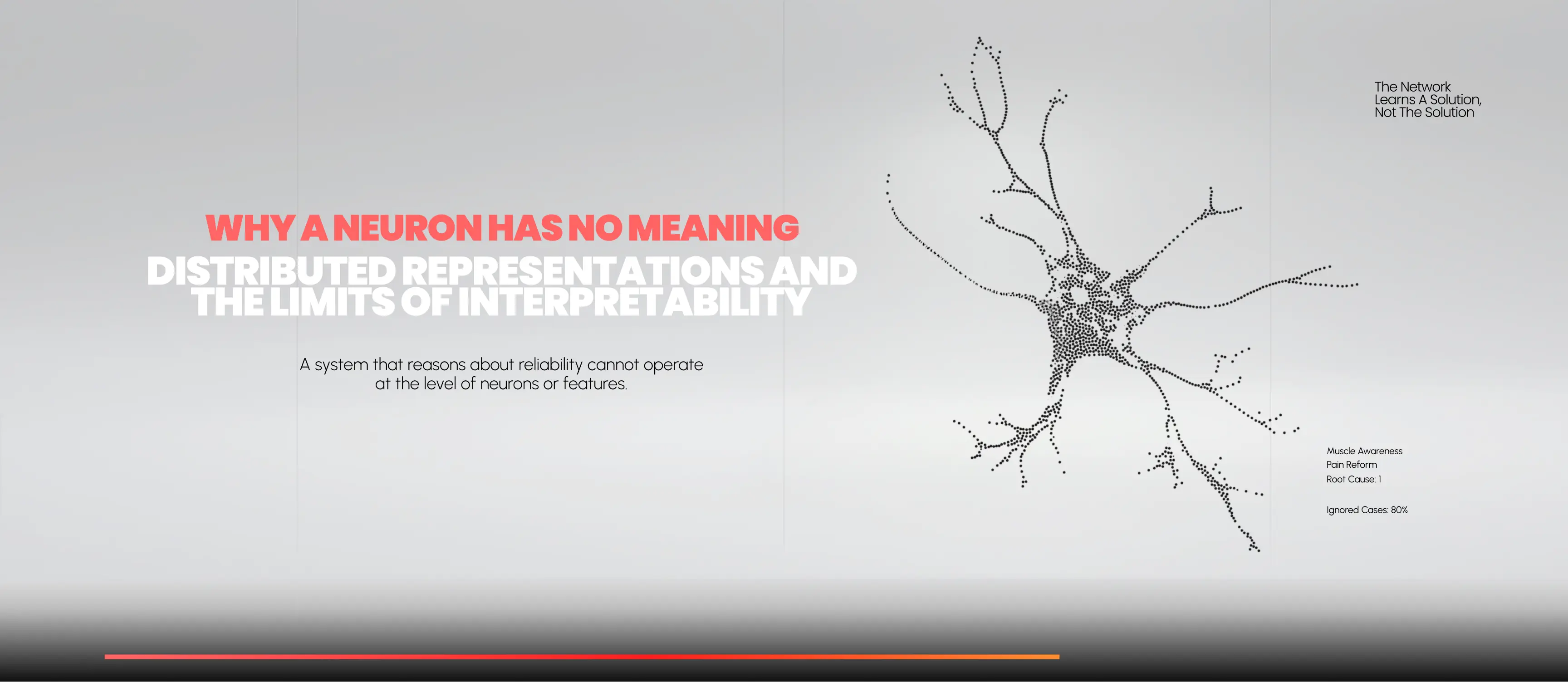
In modern neural networks, a single neuron has no stable semantic meaning. Nor does a single dimension, layer, or activation pattern taken in isolation. Meaning in deep learning systems is not localized. It is distributed, encoded across patterns of activity and relationships in high-dimensional space.
This fact is not a quirk of implementation. It is a structural property of how neural networks learn. And misunderstanding it is one of the primary reasons why explainability efforts struggle to capture real model behavior.
The Origin of the Intuition and Why It Fails
Early symbolic AI systems were built around explicit representations. Variables stood for concepts. Rules encoded logic. If a system “knew” something, you could point to where that knowledge lived.
Neural networks operate under a fundamentally different regime. They do not store concepts as symbols. They learn functions, mappings from inputs to outputs, by adjusting millions or billions of parameters through gradient descent. In doing so, they distribute information across the network to minimize loss, not to preserve interpretability.
The result is a system in which:
- No single neuron corresponds to a human concept
- No dimension consistently represents the same property across contexts
- No local inspection reveals global meaning
This is not a limitation of tooling. It is how representation learning works.
What Distributed Representation Actually Means
A distributed representation is one in which a concept is encoded not by a single unit, but by a pattern across many units.
Consider a vision model trained to recognize
pedestrians. There is no “pedestrian neuron.” Instead:
some neurons respond weakly to
vertical edges, others to texture,
others to motion cues, and others
to contextual relationships.
The concept of “pedestrian” emerges only when many activities combine in a particular geometric configuration. Alter that configuration slightly, and the meaning changes. Remove one neuron, and the concept still exists, just degraded.
This is why neural networks are robust to noise and damage, but also why they are opaque.
Meaning is not stored in neurons.
It is stored between them.
Why Individual Neurons Are Unstable
Even when researchers identify neurons that appear to correlate with specific features: faces, objects, syntactic roles, those correlations are rarely stable.
A neuron that activates for “faces” in one context may activate for entirely different patterns in another. Small changes in training data, architecture, or random initialization can reassign semantic roles across the network.
Technically, this happens because:
- Representations are learned up to arbitrary rotations in latent space
- Many configurations yield equivalent performance
- Gradient descent has no incentive to preserve semantic alignment
The network learns a solution,
not the solution.
As a result, semantic meaning cannot be pinned to individual components without losing generality.
Why Dimensions Don’t Help Either
It might be tempting to move from neurons to dimensions. Surely one dimension in a latent vector corresponds to some interpretable axis: brightness, size, sentiment, risk.
But latent spaces are not axis-aligned with human concepts.
Rotate the representation space, even slightly, and the model’s behavior remains unchanged, while every individual dimension shifts. This rotational symmetry means that dimensions are arbitrary coordinate choices, not semantic containers.
Meaning survives rotation. Individual dimensions do not.
Where Meaning Actually Lives: Geometry
If meaning is not in neurons or dimensions, where is it?
It lives in geometry.
Specifically:
- In relative distances between representations
- In densities that reflect training support
- In trajectories as inputs evolve over time
- In clusters formed by similar inputs
- In boundaries where classes overlap or separate
Two inputs are similar to the model if they are close in latent space. An input is unfamiliar if it lies in a sparse region. A failure mode exists if a cluster of representations consistently produces incorrect outputs.
These are geometric properties. They are relational, not local.
This is why feature attribution and neuron inspection struggle: they look for meaning in parts, while meaning exists in structure.
Why This Breaks Traditional Explainability
Most explainability techniques implicitly assume that meaning is localized:
- Saliency maps highlight pixels
- Neuron visualizations seek semantic units
- SHAP values rank features
These methods can be useful for surface-level insights, but they cannot explain behavioral reliability. They do not reveal whether a decision was made in a stable, well-supported region of the model’s experience or in a fragile, extrapolative one.
A model can focus on the “right” features and still be wrong because the representation as a whole is unstable.
Understanding behavior requires understanding geometry, not attribution.
The Debugging Implication
When an AI system fails, engineers often ask: Which neuron caused this? or Which feature mattered most?
But this is the wrong question.
Failures arise from:
- Interactions across many neurons
- Relationships learned implicitly during training
- Positions in latent space
Because these structures are not exposed, failures appear:
- Non-deterministic
- Difficult to reproduce
- Non-local
- Resistant to targeted fixes
The system “worked” until it didn’t, and no single component can be blamed.
Why Cognitive AI Must Operate Above the Neuron Level
If meaning is distributed, then cognition must be distributed as well.
A system that reasons about reliability cannot operate at the level of neurons or features. It must operate at the level where meaning exists: the geometry of internal representations.This is the insight that underpins Cognitive AI.
Rather than asking what feature mattered, a cognitive system asks:
- Where does this representation lie relative to known successes and failures?
- How dense is the surrounding region?
- How close is this input to ambiguity or novelty?
- Does this trajectory resemble past breakdowns?
These questions cannot be answered by inspecting neurons. They require mapping, monitoring, and reasoning over latent space.
How SQUINT Cognition Leverages Distributed Representation
SQUINT Cognition is built around the reality that neurons have no meaning, but geometry does.
During development, SQUINT maps the latent representation space of a model, identifying:
- Clusters of reliable behavior
- Ambiguous overlaps
- Regions associated with historical errors
- Zones of novelty