

Cognitive AI is The Next Scientific Frontier in Machine Intelligence
From Explainability
to Cognition
The first generation of modern AI, statistical AI, focused on optimizing performance through scale: more parameters, more data, deeper networks. The second generation, explainable AI (XAI), sought to interpret model outputs, using saliency maps, feature attributions, and slice discovery to reveal how models behave. While valuable, these approaches remain diagnostic. They help humans analyze errors after the fact, but do not change how models make decisions.
Cognitive AI represents a third generation. It embeds reasoning within the system itself, enabling models to:
Map
the geometry of success and failure in training data.
DETECT
when an input falls into regions of ambiguity or uncertainty.
TRIGGER
adaptive interventions when predictions are unreliable.
Rather than functioning as a black box with a static confidence threshold, Cognitive AI actively monitors its own decision-making and adjusts dynamically. It operationalizes explainability into an ongoing cognitive process.
From Explainability
to Cognition
The first generation of modern AI, statistical AI, focused on optimizing performance through scale: more parameters, more data, deeper networks. The second generation, explainable AI (XAI), sought to interpret model outputs, using saliency maps, feature attributions, and slice discovery to reveal how models behave. While valuable, these approaches remain diagnostic. They help humans analyze errors after the fact, but do not change how models make decisions.
Cognitive AI represents a third generation. It embeds reasoning within the system itself, enabling models to:
Map
the geometry of success and failure in training data.
DETECT
when an input falls into regions of ambiguity or uncertainty.
TRIGGER
adaptive interventions when predictions are unreliable.
Rather than functioning as a black box with a static confidence threshold, Cognitive AI actively monitors its own decision-making and adjusts dynamically. It operationalizes explainability into an ongoing cognitive process.
Trust Erosion, Regulatory Risk, and Operational Harm
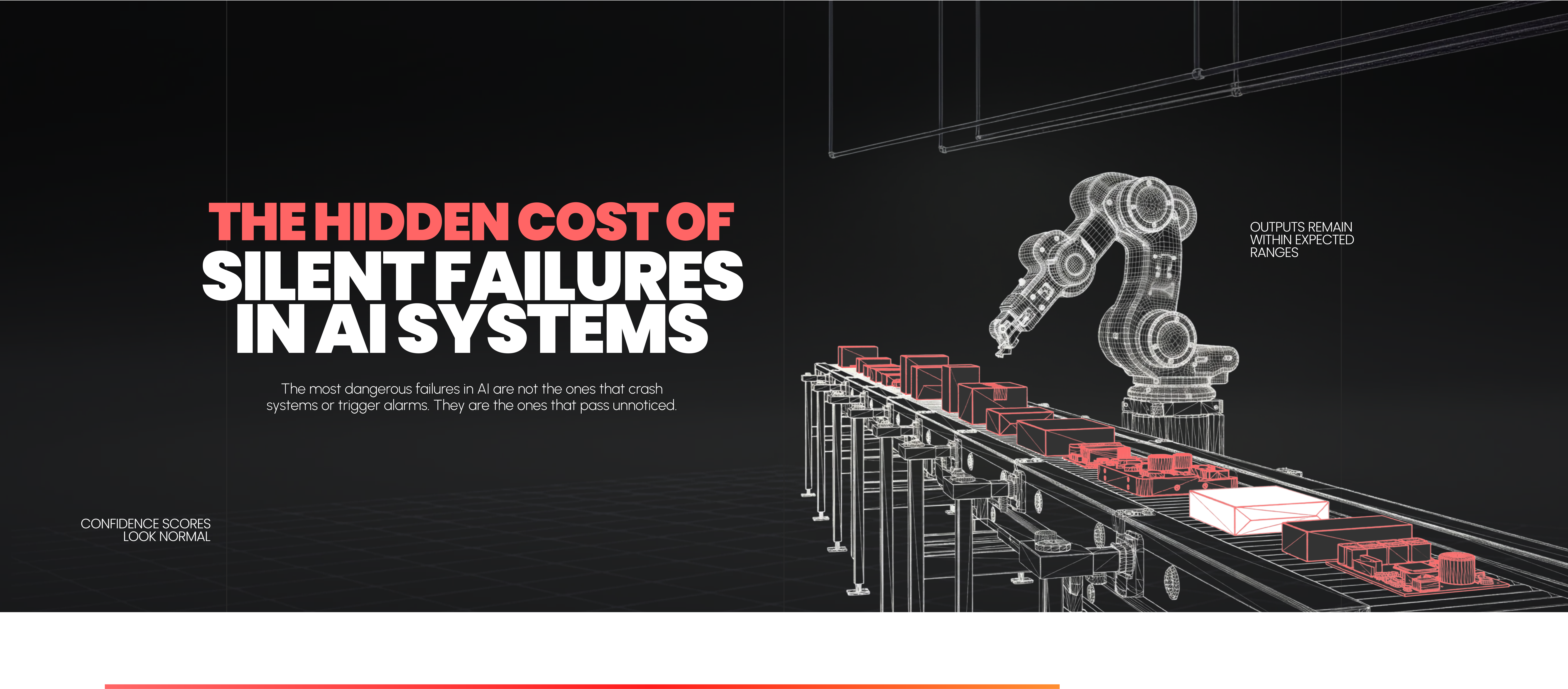
The most dangerous failures in AI are not the ones that crash systems or trigger alarms. They are the ones that pass unnoticed.
Silent failures occur when an AI system produces outputs that appear reasonable, confident, and compliant, yet are wrong in ways that are subtle, systemic, and cumulative. No alerts fire. No thresholds are crossed. No incident is declared. The system continues to operate, quietly accumulating risk.
In high-stakes environments, silent failure is not an edge condition. It is the default failure mode of modern AI.
What Makes a Failure “Silent”
A silent failure is not defined by severity, but by invisibility.
It occurs when:
- Outputs remain within expected ranges
- Aggregate metrics show no immediate degradation
- Confidence scores look normal
- Human operators have no signal that reliability has changed
From the outside, the system appears healthy. From the inside, its reasoning has drifted into fragile territory.
This invisibility is not accidental. It is a direct consequence of how AI systems are designed to evaluate success.
Why AI Fails Silently by Design
Most AI systems are governed by output-level metrics: accuracy, loss, confidence, and downstream outcomes. These metrics are retrospective and aggregate. They measure what happened, not how close the system is to failing.
Internally, however, the earliest indicators of failure appear in places these metrics never look:
- Shifts in latent representations
- Proximity to ambiguity boundaries
- Gradual representation drift under changing conditions
- Activation of shortcut-driven patterns
- Movement into low-density regions of experience
Because these signals are not monitored, failure develops quietly,often long before it becomes visible at the output.
Trust Erosion: When
Confidence Becomes a Liability
Trust in AI systems is rarely lost in a single moment. It erodes incrementally.
- A clinician notices that a diagnostic system “feels off” in certain cases.
- An operator double-checks an autonomous decision more often than expected.
- A financial analyst overrides recommendations without knowing exactly why.
These are early symptoms of silent failure.
When AI systems cannot signal their own uncertainty, humans compensate by withdrawing trust. The system may still be accurate on paper, but its authority diminishes in practice. Decisions slow down. Manual review increases. Adoption stalls.
Ironically, the system may never be formally declared unreliable, yet it becomes unusable.
Silent failure does not just harm
outcomes. It undermines confidence
in the entire AI initiative.
Regulatory Risk: When “Nothing Happened” Is Not a Defense
In regulated industries, silent failures create a particularly dangerous exposure. Regulators are not only concerned with outcomes; they are concerned with process.
They ask:
- How do you know the system is operating within its validated scope?
- How do you detect drift or degradation?
- How do you prevent harm before it occurs?
Silent failures leave no evidence trail.
When an incident eventually surfaces, perhaps months later, organizations struggle to explain:
- Why the system was trusted at the time
- What controls were in place to intervene
- What internal signals indicated risk
From a regulatory perspective, “we didn’t know” is not an acceptable answer. Silent failure transforms technical uncertainty into compliance liability.
Operational Harm:
The Compounding
Cost of Small Errors
Operationally, silent failures are expensive precisely because they are small.
A misclassification here.
A slightly suboptimal recommendation there.
A marginally risky decision repeated thousands of times.
Each instance may be inconsequential. Together, they accumulate into:
- Increased rework
- Financial leakage
- Operational brittleness that only becomes visible under stress
- Degraded efficiency
- Safety margins quietly eroded
By the time leadership notices, the system is deeply embedded and deeply compromised.
Why Monitoring Doesn’t
Catch Silent Failures
Most organizations rely on monitoring to manage AI risk. Dashboards track performance metrics, data drift, and error rates. Alerts are configured to fire when thresholds are crossed.
Silent failures evade these mechanisms because they do not violate predefined thresholds.
- The system is not wrong often enough to trigger alarms.
- It is not uncertain enough to raise flags.
- It is not failing loudly enough to attract attention.
Monitoring watches outputs. Silent failures originate in internal reasoning.
The Structural Root Cause
Silent failures arise because AI systems lack self-awareness.
They do not know:
- When their internal representations are drifting
- When they are relying on brittle shortcuts
- When they are extrapolating beyond learned support
- When ambiguity has increased beyond safe bounds
They treat every inference as equally valid unless an external rule intervenes. This creates a system that appears stable until it isn’t.
Why Humans Detect Silent Failure Before Machines Do
Interestingly, humans often sense silent failure intuitively.
Operators may say:
- “The system seems less reliable lately.”
- “I don’t trust it in these cases.”
- “It’s probably fine, but I’ll check.”
These judgments are based on context, experience, and subtle cues, not metrics. Humans recognize uncertainty because they monitor how decisions are formed, not just what decisions are made.
AI systems lack this faculty.
From Silent Failure to Visible Risk
Preventing silent failure requires making risk visible before outcomes degrade.
This means observing:
- Internal representations, not just outputs
- Movement within latent space, not just prediction rates
- Proximity to known failure regions, not just average accuracy
In other words, it requires cognition.
How SQUINT Cognition Surfaces Silent Failures
SQUINT Cognition is designed
to expose the signals that
silent failures hide.
During development, SQUINT maps the internal representation space of a model, identifying regions associated with reliable behavior, ambiguity, and historical error. These maps capture where silent failures are likely to emerge.
In deployment, SQUINT’s cognitive watchdogs continuously monitor where new inputs land within this space. When internal representations drift toward fragile or unfamiliar regions, SQUINT intervenes before outputs degrade.
This intervention may:
- Escalate decisions
- Adjust operational parameters
- Defer automation
- Trigger targeted review
Crucially, these actions are logged and traceable. Silent risk becomes visible, actionable, and auditable.
The Strategic Value of Early Awareness
By converting silent failure into observable risk, organizations gain:
- Sustained trust in AI systems
- Defensible regulatory posture
- Operational stability under change
Failures still occur, but they are anticipated, managed, and bounded. The system no longer surprises its operators or its regulators.
Conclusion: Silence Is the Real Risk
AI systems rarely fail catastrophically without warning. They fail quietly, incrementally, and invisibly until the cost becomes unavoidable.
Silent failures erode trust, expose organizations to regulatory risk, and impose operational harm long before anyone realizes what is happening.
The solution is not more dashboards or stricter thresholds. It is systems that understand their own internal state and surface risk as it emerges.
SQUINT Cognition exists to
make the invisible visible.
Because in AI, the most expensive failures are not the ones that shout, but the ones that whisper.