Cognitive AI is The Next Scientific Frontier in Machine Intelligence
From Explainability
to Cognition
The first generation of modern AI, statistical AI, focused on optimizing performance through scale: more parameters, more data, deeper networks. The second generation, explainable AI (XAI), sought to interpret model outputs, using saliency maps, feature attributions, and slice discovery to reveal how models behave. While valuable, these approaches remain diagnostic. They help humans analyze errors after the fact, but do not change how models make decisions.
Cognitive AI represents a third generation. It embeds reasoning within the system itself, enabling models to:
Map
the geometry of success and failure in training data.
DETECT
when an input falls into regions of ambiguity or uncertainty.
TRIGGER
adaptive interventions when predictions are unreliable.
Rather than functioning as a black box with a static confidence threshold, Cognitive AI actively monitors its own decision-making and adjusts dynamically. It operationalizes explainability into an ongoing cognitive process.
From Explainability
to Cognition
The first generation of modern AI, statistical AI, focused on optimizing performance through scale: more parameters, more data, deeper networks. The second generation, explainable AI (XAI), sought to interpret model outputs, using saliency maps, feature attributions, and slice discovery to reveal how models behave. While valuable, these approaches remain diagnostic. They help humans analyze errors after the fact, but do not change how models make decisions.
Cognitive AI represents a third generation. It embeds reasoning within the system itself, enabling models to:
Map
the geometry of success and failure in training data.
DETECT
when an input falls into regions of ambiguity or uncertainty.
TRIGGER
adaptive interventions when predictions are unreliable.
Rather than functioning as a black box with a static confidence threshold, Cognitive AI actively monitors its own decision-making and adjusts dynamically. It operationalizes explainability into an ongoing cognitive process.
Shortcut learning is one of the most persistent and most misunderstood failure modes in modern AI systems. When models behave unexpectedly in deployment, the explanation is often framed in moral or procedural terms: biased data, flawed labels, or careless training practices. While these factors matter, they obscure a deeper truth.
Shortcut learning is a natural geometric consequence of how neural networks learn.
To understand why shortcut learning is so difficult to detect, debug, and prevent, we must stop treating it as a surface-level issue and examine where it actually lives: inside the geometry of latent representation space.
What Shortcut Learning Really Is
Shortcut learning occurs when a model relies on features that are predictive in the training data but not causally related to the task it is meant to solve.
Classic examples include:
- Medical models learning scanner artifacts instead of pathology
- Vision systems using background or lighting instead of object structure
- Language models exploiting dataset formatting cues instead of semantics
- Risk models keying off proxies correlated with protected attributes
From the model’s perspective, none of this is wrong. Gradient descent rewards whatever reduces loss most efficiently. If a shortcut feature provides a strong signal, the model will use it, regardless of whether that signal is meaningful outside the training distribution. Shortcut learning is optimization working exactly as designed.
Why Shortcut Learning Is Invisible at the Surface
Shortcut learning rarely reveals itself in aggregate metrics.
In training and validation:
- Accuracy improves
- Loss decreases
- Confidence increases
Because shortcuts are genuinely predictive in the training distribution, performance looks excellent. Feature attribution methods often reinforce this illusion by highlighting the shortcut as “important,” further validating the model’s behavior.
The problem does not appear until the shortcut breaks, when the context changes, the proxy disappears, or the correlation no longer holds by then, the system fails abruptly.
Shortcut Learning Is a Geometric Phenomenon
To understand why shortcut learning is so persistent, we must examine how models encode information internally.
Neural networks transform inputs into high-dimensional latent representations. In this space:
- Similarity corresponds to distance
- Decision boundaries separate regions
- Patterns form clusters
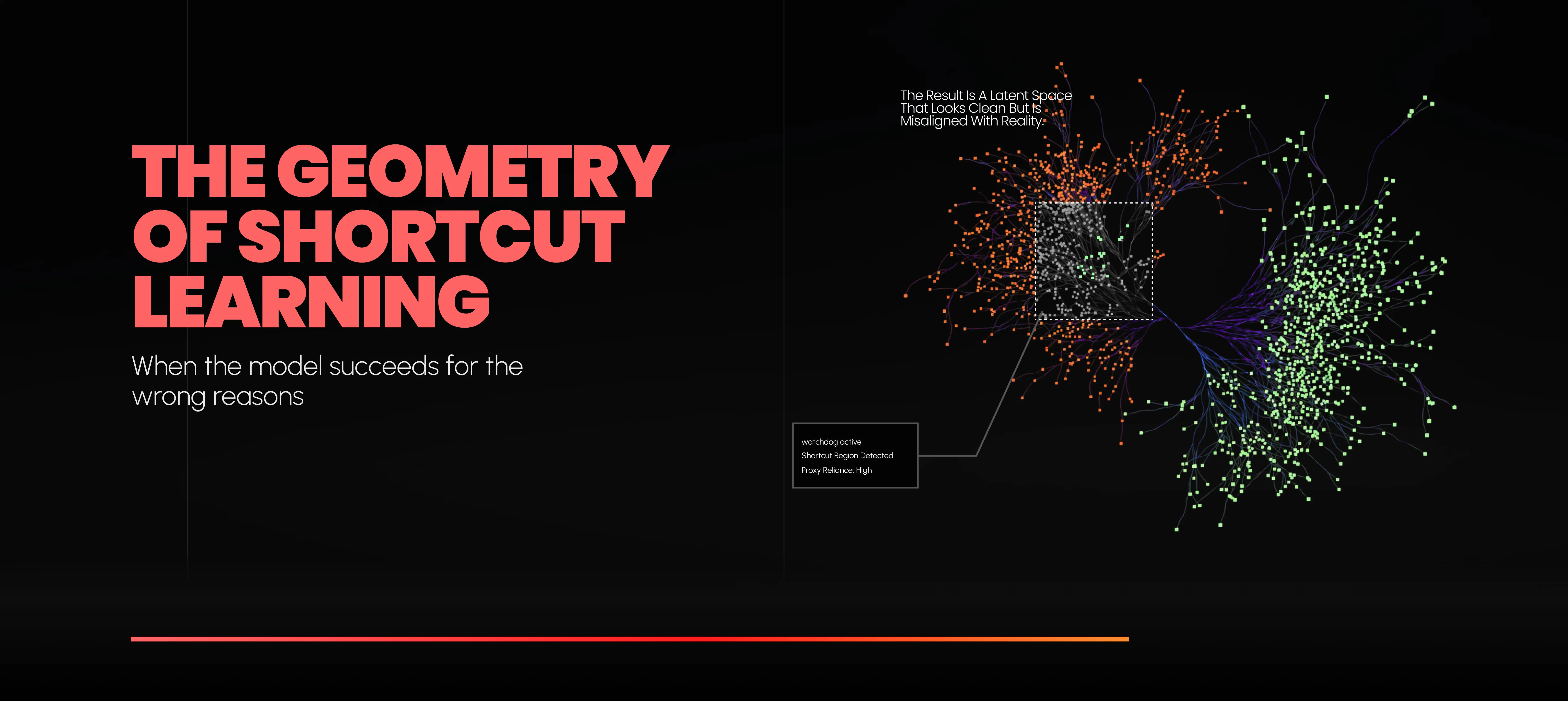
When a shortcut feature dominates training, it reshapes this geometry. Instead of organizing representations around stable, causal structure, the model compresses inputs along the shortcut dimension. Inputs that share the shortcut feature collapse into tight clusters, even if they differ meaningfully in the true task-relevant sense.
The result is a latent space that looks clean but is misaligned with reality.
How Geometry Reveals Shortcut Learning
Shortcut learning leaves distinct geometric signatures:
- Artificially tight clusters formed around shortcut features rather than causal structure.
- Low intra-cluster variance that disappears when the shortcut is removed.
- Decision boundaries aligned with proxy features, not semantic distinctions.
- Fragile separation that collapses under modest context changes.
- Sparse support when the shortcut signal weakens or vanishes.
These signatures are invisible in input space and often invisible in output behavior. They are visible only when the structure of representation space is examined.
Why Feature Attribution Cannot Fix Shortcut Learning
Feature attribution attempts to trace decisions back to input features. In the presence of shortcut learning, attribution often works too well. It correctly identifies the shortcut as influential because it is.
But attribution cannot answer the critical questions:
- Is this feature structurally fragile?
- Does reliance on this feature define a high-risk region of latent space?
- Will this geometry remain stable when context changes?
Attribution explains what influenced a decision.
It cannot explain whether that influence is safe.
Shortcut learning is not a feature-level problem. It is a representational one.
Why More Data Doesn’t Eliminate Shortcuts
A common response to shortcut learning is to collect more data. While additional data can help, it rarely solves the problem entirely.
If the shortcut remains predictive in the expanded dataset, the model will continue to use it. Worse, adding more data can strengthen the shortcut, making the geometry even more dependent on the proxy feature.
Eliminating shortcuts requires not just more data, but awareness of how representations are structured and whether that structure aligns with the task’s true semantics.
Shortcut Learning and Deployment Failure
Shortcut-driven geometry is brittle by design.
When the environment changes:
- Scanners are upgraded
- Populations differ
- Lighting shifts
- Formats change
The shortcut signal weakens or disappears. The tightly clustered regions of latent space disperse. Decision boundaries lose meaning. Representations fall into sparse, unstable regions. From the outside, the failure appears sudden. From the inside, the geometry has been fragile all along.
This is why shortcut learning is a leading cause of deployment failures that are:
- Hard to predict
- Hard to debug
- Hard to reproduce
Why Traditional Safeguards Miss Shortcut Learning
Most safeguards operate at the output level:
- Accuracy checks
- Calibration metrics
- Calibration metrics
- Drift monitoring on inputs
Shortcut learning does not violate these signals until it’s too late. As long as the shortcut holds, the model appears healthy. There is no alert for “your representation geometry is misaligned with reality.”
The system has no concept of why it is succeeding and therefore no way to recognize when that reason becomes invalid.
From Shortcut Detection to Cognitive Awareness
Preventing shortcut-driven failures requires shifting from outcome-based evaluation to representation-based reasoning.
Instead of asking:
Is the model accurate?
A cognitive system asks:
What structure is the model using to be accurate, and how stable is that structure under change?
This reframing makes shortcut learning detectable before it causes failure.
How SQUINT Cognition Makes Shortcut Learning Visible
SQUINT Cognition is designed to surface the geometry of shortcut learning.
During development, SQUINT analyzes latent representations to:
- Identify clusters driven by proxy features
- Measure how tightly representations depend on specific correlations
- Detect misalignment between representational structure and task semantics
- Associate these regions with historical brittleness
These insights become operational knowledge.
At runtime, SQUINT’s cognitive watchdogs monitor whether new inputs are being processed through shortcut-dominated regions of latent space. When reliance on a fragile geometry is detected, SQUINT intervenes before the shortcut breaks.
The system can:
- Escalate to more robust models
- Defer decisions
- Adjust operational behavior
- Flag the decision for review