Cognitive AI is The Next Scientific Frontier in Machine Intelligence
From Explainability
to Cognition
The first generation of modern AI, statistical AI, focused on optimizing performance through scale: more parameters, more data, deeper networks. The second generation, explainable AI (XAI), sought to interpret model outputs, using saliency maps, feature attributions, and slice discovery to reveal how models behave. While valuable, these approaches remain diagnostic. They help humans analyze errors after the fact, but do not change how models make decisions.
Cognitive AI represents a third generation. It embeds reasoning within the system itself, enabling models to:
Map
the geometry of success and failure in training data.
DETECT
when an input falls into regions of ambiguity or uncertainty.
TRIGGER
adaptive interventions when predictions are unreliable.
Rather than functioning as a black box with a static confidence threshold, Cognitive AI actively monitors its own decision-making and adjusts dynamically. It operationalizes explainability into an ongoing cognitive process.
From Explainability
to Cognition
The first generation of modern AI, statistical AI, focused on optimizing performance through scale: more parameters, more data, deeper networks. The second generation, explainable AI (XAI), sought to interpret model outputs, using saliency maps, feature attributions, and slice discovery to reveal how models behave. While valuable, these approaches remain diagnostic. They help humans analyze errors after the fact, but do not change how models make decisions.
Cognitive AI represents a third generation. It embeds reasoning within the system itself, enabling models to:
Map
the geometry of success and failure in training data.
DETECT
when an input falls into regions of ambiguity or uncertainty.
TRIGGER
adaptive interventions when predictions are unreliable.
Rather than functioning as a black box with a static confidence threshold, Cognitive AI actively monitors its own decision-making and adjusts dynamically. It operationalizes explainability into an ongoing cognitive process.
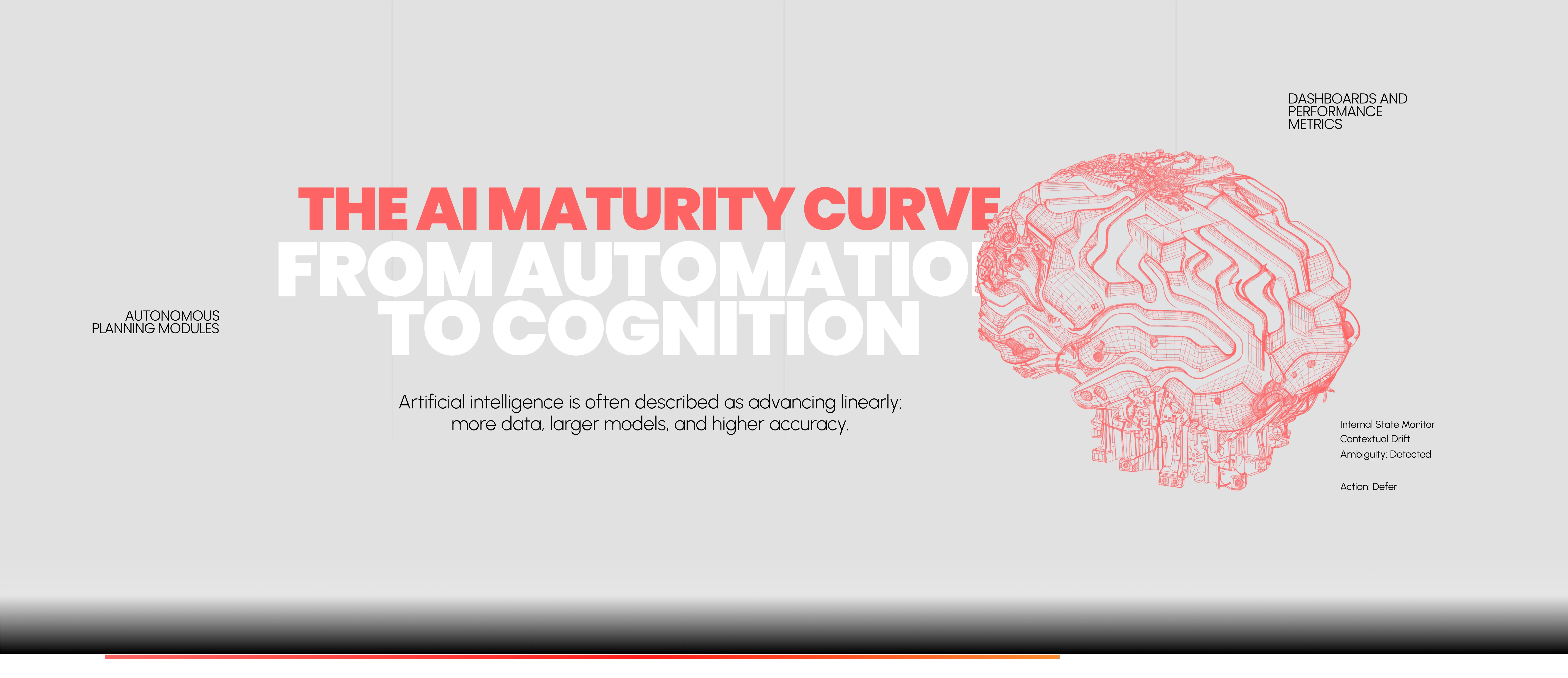
Artificial intelligence is often described as advancing linearly: more data, larger models, and higher accuracy. But in practice, AI evolves not as a straight line, but as a series of qualitative shifts in how systems behave, what they can be trusted to do, and where they fail.
These shifts form an AI maturity curve, one that many organizations are now encountering firsthand.
At the early stages of this curve, AI automates tasks. Later, it optimizes decisions. But only at its most mature does AI begin to regulate itself: recognizing uncertainty, adapting behavior, and operating safely in complex, real-world environments. That final stage is not automation. It is cognition.
Understanding this curve is essential for organizations deploying AI in high-stakes settings, because failures almost always occur when systems are asked to operate beyond their level of maturity.
Stage 1: Automation
The first stage of AI maturity is automation. Systems at this stage are designed to replace or accelerate well-defined, repetitive tasks. They operate under stable assumptions and narrow scopes.
Examples include: document classification, basic image recognition, rule-augmented decision engines, and anomaly detection in controlled environments.
At this stage, success is measured by accuracy and throughput. The system is expected to perform a function correctly most of the time, under conditions that closely resemble its training data.
Limitations:
Automation breaks down quickly when conditions change. These systems do not understand context, do not reason about uncertainty, and do not adapt behavior when assumptions are violated. They automate tasks - but they do not manage risk.
Stage 2: Prediction and Optimization
As models become more sophisticated, AI moves into prediction and optimization. Systems begin to recommend actions, forecast outcomes, and optimize objectives.
Examples include: demand forecasting, credit scoring, medical triage models, and autonomous planning modules.
At this stage, AI influences decisions rather than merely executing them. Performance improves dramatically, but so does exposure to failure. Optimization amplifies error: when predictions are wrong, the consequences are larger.
Key characteristic:
These systems assume that confidence equals reliability. They optimize expected outcomes without understanding when predictions are unstable.
Limitation:
Prediction without self-assessment creates brittle autonomy. The system cannot recognize when it is extrapolating, operating in ambiguous conditions, or relying on spurious correlations.
Stage 3: Explainability and Oversight
As failures emerge, organizations introduce explainability and monitoring. This is the third stage of maturity.
Explainable AI provides:
- Feature attributions
- Post-hoc rationales
- Saliency maps
- Dashboards and performance metrics
These tools help humans understand what happened after a decision was made.
What this stage fixes:
Opacity. Stakeholders gain visibility into model behavior.
What it does not fix:
Control. Explainability does not change how the model behaves in real time. It does not prevent failure; it only helps explain it later.
This is a critical inflection point. Many organizations mistake explainability for maturity. In reality, it is a diagnostic layer, not a governing one.
Stage 4: Conditional Autonomy
In some systems, autonomy is constrained through rules, thresholds, or fallback logic. Decisions are allowed only under predefined conditions.
Examples include: confidence thresholds, rule-based overrides, and human-in-the-loop escalation.
This introduces conditional autonomy: the system can act, but only within hard-coded boundaries.
Limitation:
These boundaries are static. They do not adapt to new failure modes, novel contexts, or gradual drift. They rely on output-level signals that often fail to capture internal instability.
Conditional autonomy is safer than blind autonomy, but it remains brittle.
Stage 5: Cognition
Cognition represents a qualitative shift in AI maturity.
At this stage, systems do not merely act or predict, they reason about their own reliability.
A cognitive AI system:
- Monitors its internal representations in real time
- Recognizes ambiguity, novelty, and drift
- Understands where it sits within its learned experience
- Adapts behavior before committing to action
Instead of asking only “What should I do?”, the system also asks:
- “How well do I understand this situation?”
- “Does this resemble contexts where I have failed before?”
- “Should I proceed, slow down, or defer?”
Cognition transforms autonomy from absolute authority into conditional, context-aware judgment.
Why the Curve Matters
Most AI failures occur when systems are deployed beyond their maturity level:
- Automation systems asked to handle complexity
- Predictive systems granted autonomy without self-assessment
- Explainable systems expected to prevent failures rather than explain them
The AI maturity curve explains why adding more data or more parameters does not resolve these failures. Maturity is not about scale, it is about self-awareness and control.
Cognition as the Foundation of Trust
Trust emerges when systems behave predictably under uncertainty. Humans trust other humans not because they are always correct, but because they recognize when they might be wrong.
Cognitive AI mirrors this behavior. It does not promise perfection. It promises judgment.
By embedding contextual intelligence and self-regulation into the AI lifecycle from development to deployment to ongoing operation, cognition enables systems to evolve safely as environments change.
The Role of SQUINT Cognition
SQUINT Cognition is designed to operationalize the final stage of the AI maturity curve.
Rather than treating internal representations as opaque byproducts, SQUINT actively maps and monitors them. It learns where models are reliable, where they are fragile, and how those regions shift over time. Runtime watchdogs intervene before failures occur, adjusting system behavior in response to internal signals, not external damage.
This transforms AI from a tool that reacts to errors into a system that anticipates them.
Conclusion: Maturity Is Not Optional
As AI systems take on greater responsibility, maturity becomes non-negotiable. Automation without cognition leads to brittle autonomy. Explainability without control leads to hindsight, not safety.
The future of AI lies not in acting faster, but in acting wiser.
That is the path from automation to intelligence.