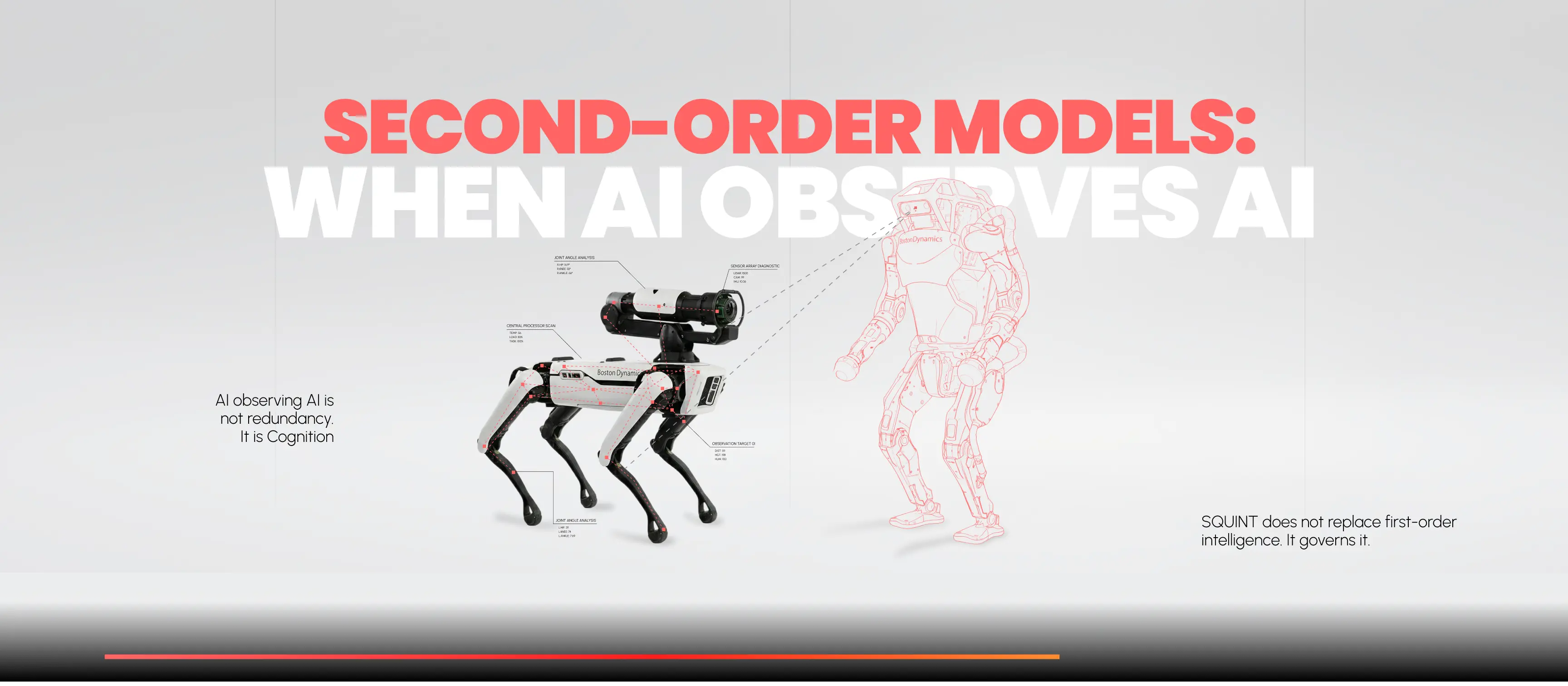
Most artificial intelligence systems today are first-order systems. They take inputs, transform them through learned representations, and produce outputs. Their entire purpose is to act: to classify, predict, recommend, or control.
- Once the forward pass is complete, the system moves on. There is no reflection, no assessment of how the decision was formed, and no evaluation of whether the conditions under which the decision was made are stable or trustworthy.
- In human cognition, observation and action are inseparable. We continuously monitor our own reasoning: recognizing uncertainty, hesitation, and error before committing to decisions. AI systems lack this capability. They operate as if every inference is equally valid, regardless of context.
First-Order Intelligence: Powerful but Blind
A first-order model is optimized to perform a task. Its objective function encodes what success looks like: minimizing error, maximizing reward, and optimizing likelihood. During inference, the model computes a result and returns it with a confidence score.
Crucially, first-order models are not trained
to answer questions such as:
- Is this decision being made under conditions I understand?
- Does this input resemble contexts where I have failed before?
- Is my internal representation stable or fragile right now?
From a technical standpoint, the model has no incentive to ask these questions. Its loss function does not reward caution, introspection, or self-regulation. It rewards output accuracy, nothing more.
Why Self-Assessment
Cannot Be Embedded in
First-Order Models
It is tempting to believe that a single model could both act and assess itself. In practice, this does not work.
The same representations used to make a decision cannot reliably evaluate that decision’s trustworthiness. This is not a matter of missing features; it is a structural limitation.
A first-order model is optimized to compress information in ways that are useful for prediction. In doing so, it discards information about uncertainty, density, and ambiguity that would be essential for self-evaluation. Asking the same model to judge its own reliability is like asking a camera to photograph itself without a mirror.
This is why confidence scores, thresholds, and internal heuristics consistently fail to predict real-world errors. They are first-order signals masquerading as second-order judgment.
What a Second-Order
Model Is
A second-order model is not another predictor. It does not solve the same task as the primary system. Instead, it observes the process by which the primary system reaches its decisions.
Where the first-order model asks:
What is the answer?
The second-order model asks:
How was this answer formed, and should it be trusted?
Technically, second-order models operate on:
- Intermediate representations
- Latent embeddings
- Internal state trajectories
- Cross-modal consistency signals
- Temporal evolution of representations
They are trained not on labels alone, but on relationships between internal states and historical outcomes: successes, failures, ambiguity, and drift.
This distinction is fundamental. Second-order models reason about reliability, not correctness.
AI Observing AI: A Shift in
Control Architecture
Introducing a second-order model changes the control structure of an AI system.
In traditional pipelines:
Input → Model → Output → Action
With second-order cognition:
Input → Model → Internal State
↓
Second-Order Model
↓
Trust / Risk Assessment
↓
Adapted Action or Escalation
The second-order model sits inside the decision loop, not outside it. It does not wait for errors to surface. It evaluates risk as the decision forms.
This enables behaviors that first-order systems cannot support:
- Blocking actions in unstable regions
- Escalating to safer or more robust models
- Deferring decisions to humans
- Altering operational policies in real time
- Entering minimal-risk modes when uncertainty rises
This is not monitoring. It is regulation.
Why Second-Order Models
Enable Self-Correction
Self-correction is often misunderstood as retraining. In reality, retraining addresses past errors, not imminent ones.
Second-order models enable
behavioral self-correction:
- They recognize precursors to failure in latent space.
- They intervene before an incorrect action is executed.
- They adapt system behavior without changing model weights.
Over time, as new contexts and failure modes are observed, the second-order model’s understanding evolves. The system becomes better not just at predicting, but at judging when prediction is safe.
This is the difference between learning and cognition.
Why This Matters in
High-Stakes Systems
In autonomous vehicles, medical diagnostics, financial trading, and industrial control, errors are not equally costly. Some decisions demand caution, others decisiveness. First-order models cannot make this distinction.
Second-order models make it possible to:
- Slow down when sensors degrade
- Defer diagnoses in ambiguous medical cases
- Halt trades during regime shifts
- Require human oversight in novel situations
The SQUINT Cognition
Approach
SQUINT Cognition is built around second-order models as a first-class architectural element.
During development, SQUINT maps the internal representation space of a primary model, identifying regions of reliability, ambiguity, and historical failure. These maps become the training substrate for second-order cognitive watchdogs.
In production, these watchdogs continuously observe the internal state of the primary system. When risk emerges: due to drift, novelty, or ambiguity, the watchdog intervenes before the system acts.
Importantly, these interventions are:
- Contextual
- Traceable
- Auditable
- Grounded in the model’s own internal behavior
From Automation to
Reflection
The introduction of second-order models marks a transition in how we think about AI systems. Intelligence is no longer defined solely by the ability to produce outputs, but by the ability to reflect on the process that produced them.
This is how AI systems move from automation to cognition from acting blindly to acting with awareness.
Conclusion: Intelligence
Requires Observation
An AI system that cannot observe itself cannot regulate itself. And a system that cannot regulate itself cannot be trusted with autonomy.
Second-order models provide the missing layer of observation that modern AI systems require. They allow AI to reason not just about the world, but about its own understanding of the world.
AI observing AI is not redundancy.
It is cognition.