

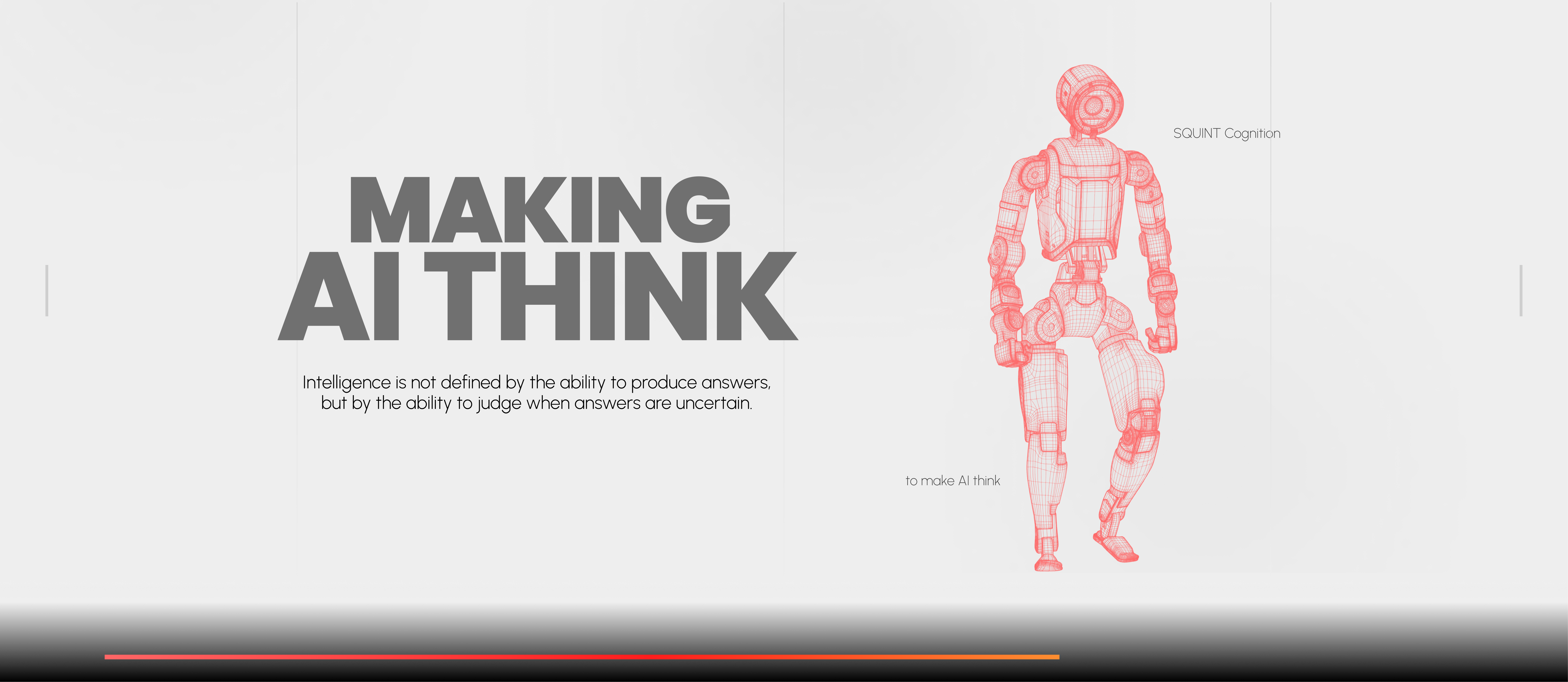
Intelligence is not defined by the ability to produce answers, but by the ability to judge when answers are uncertain. Modern AI systems lack this capacity. They correlate patterns, extrapolate from experience, and generate fluent outputs, yet they remain unaware of the limits of their own understanding.
They do not pause when conditions shift, nor do they adapt their reasoning when confronted with unfamiliar situations. As a result, today’s AI behaves less like a thinking system and more like a highly optimized statistical engine.
At SQUINT Cognition, we believe the next stage in the evolution of AI is not bigger models, but thinking models.
Our mission is simple:
to make AI think.
What Does It Mean to “Think”?
In humans, thinking is not just pattern recognition. It is the act of situating information in context, weighing ambiguity, and adapting judgment in the face of uncertainty. It is the capacity to recognize not only what we know, but also what we do not know.
Translating this to machines requires three core capabilities:
1. Contextual Awareness
Understanding how each prediction relates to the broader landscape of data and decisions.
2. Judgment Under Uncertainty
Distinguishing between reliable predictions, ambiguous cases, and situations where novelty makes prior knowledge insufficient.
3. Adaptive Reasoning
Modifying decision-making pathways in real time, invoking specialized models or deferring to human expertise when necessary.
This is what we mean by “making AI think.” It is not mimicking human cognition, it is embedding the principles of reasoning, uncertainty, and adaptability into the very fabric of machine intelligence.
The SQUINT Cognition System
Our flagship platform, SQUINT Insights Studio, operationalizes this vision through a lifecycle approach to AI development and deployment:
Discovery
During model training, SQUINT Cognition maps the internal representations of neural networks, identifying clusters of success and failure. This reveals where models are competent and where they are prone to error, turning opaque systems into transparent landscapes of reliability.
Maintenance
Over time, as data distributions shift and real-world conditions change, SQUINT Cognition monitors degradation and enables adaptive retraining, ensuring models evolve alongside their environments rather than decay unnoticed.
Deployment
Using this knowledge, SQUINT Cognition creates intelligent watchdogs - lightweight monitors embedded into production models. These watchdogs continuously evaluate predictions in real time, flagging ambiguous or high-risk cases and preventing high-confidence mistakes that traditional confidence thresholds cannot catch.
This pipeline is not a diagnostic tool
layered on top of AI, it is a cognitive
framework woven into its operation.
Changing How We Build AI Systems
The current paradigm in AI development assumes a linear process: train a model, deploy it, hope it generalizes. Failures are addressed reactively, often only after damage has been done.
SQUINT Cognition inverts this model. By embedding contextual intelligence from the start, AI systems become proactive, anticipating mistakes before they happen and adapting as conditions evolve.
This shift has profound implications:
From Accuracy to Reliability:
No longer is performance measured only by test accuracy. Instead, success is defined by resilience in complex, uncertain, real-world environments.
From Static Models to Adaptive Systems:
AI is no longer frozen at the moment of deployment: it continues to learn, monitor, and refine itself in production.
From Tools to Partners:
AI stops being a fragile assistant requiring constant oversight and becomes a dependable collaborator in decision-making.