Cognitive AI is The Next Scientific Frontier in Machine Intelligence
From Explainability
to Cognition
The first generation of modern AI, statistical AI, focused on optimizing performance through scale: more parameters, more data, deeper networks. The second generation, explainable AI (XAI), sought to interpret model outputs, using saliency maps, feature attributions, and slice discovery to reveal how models behave. While valuable, these approaches remain diagnostic. They help humans analyze errors after the fact, but do not change how models make decisions.
Cognitive AI represents a third generation. It embeds reasoning within the system itself, enabling models to:
Map
the geometry of success and failure in training data.
DETECT
when an input falls into regions of ambiguity or uncertainty.
TRIGGER
adaptive interventions when predictions are unreliable.
Rather than functioning as a black box with a static confidence threshold, Cognitive AI actively monitors its own decision-making and adjusts dynamically. It operationalizes explainability into an ongoing cognitive process.
From Explainability
to Cognition
The first generation of modern AI, statistical AI, focused on optimizing performance through scale: more parameters, more data, deeper networks. The second generation, explainable AI (XAI), sought to interpret model outputs, using saliency maps, feature attributions, and slice discovery to reveal how models behave. While valuable, these approaches remain diagnostic. They help humans analyze errors after the fact, but do not change how models make decisions.
Cognitive AI represents a third generation. It embeds reasoning within the system itself, enabling models to:
Map
the geometry of success and failure in training data.
DETECT
when an input falls into regions of ambiguity or uncertainty.
TRIGGER
adaptive interventions when predictions are unreliable.
Rather than functioning as a black box with a static confidence threshold, Cognitive AI actively monitors its own decision-making and adjusts dynamically. It operationalizes explainability into an ongoing cognitive process.
Most organizations deploying AI believe they are monitoring model stability. They track input distributions, output accuracy, confidence metrics, and performance over time. Dashboards light up when something obvious goes wrong. Alerts fire when thresholds are crossed.
And yet, many of the most damaging AI failures occur in systems that appeared perfectly healthy right up until the moment they weren’t.
This is because the most important form of change in AI systems does not occur at the input or output level. It occurs inside the model, in the space where meaning is encoded and decisions are formed. This phenomenon is known as latent drift, and it is one of the least understood and most dangerous failure modes in modern AI.
What Latent Drift Is (and What It Is Not)
Latent drift is not the same as data drift.
Data drift
refers to changes in the statistical properties of inputs.
Concept drift
refers to changes in the relationship between inputs and labels.
Latent drift
refers to changes in how a model internally represents the same kinds of inputs over time.
Crucially, latent drift can occur even when input distributions look stable and outputs appear accurate.
The model is still receiving “normal” data. It is still producing “reasonable” predictions. But the internal geometry that underpins those predictions is shifting, quietly and incrementally. This is what makes latent drift so dangerous: it is invisible to conventional monitoring.
How Latent Drift Happens
Latent drift is not a single event. It is a gradual process driven by ordinary system behavior.
Common causes include:
- Incremental changes in data sources
- Sensor aging or recalibration
- Software and firmware updates
- Evolving user behavior
- Periodic retraining or fine-tuning
- Changes in preprocessing pipelines
- Even numerical effects from long-running systems
Each change may be small. None may be alarming on its own. But together, they alter how inputs are embedded in latent space. From the outside, the system appears unchanged. From the inside, it is becoming a different system.
Why Latent Drift Is Structurally Invisible
Most monitoring tools focus on signals that are easy to measure:
- Distributions of inputs
- Aggregate performance metrics
- Confidence histograms
- Downstream outcomes
Latent representations are not part of this picture.
Internal embeddings are:
- High-dimensional
- Rarely logged or analyzed
- Transient
As a result, no one notices when:
- Dense regions become sparse
- Representations migrate toward regions associated with historical failure
- Class boundaries blur
- Internal consistency degrades across time
The system is still “working”until it suddenly isn’t.
Why Accuracy Often Masks Latent Drift
One of the most counterintuitive aspects of latent drift is that accuracy can remain high even as internal representations degrade.
This happens because:
- Average performance metrics are dominated by common cases
- Drift often affects minority or ambiguous regions first
- Interpolation still works well enough in dense regions
The system appears stable, but its margin of safety is shrinking. When a rare or borderline case finally appears, failure is abrupt and surprising. This is why latent drift is often discovered only after an incident.
Latent Drift vs. Distribution Shift
Distribution shift changes what the model sees. Latent drift changes how the model understands what it sees.
You can have:
- Stable input statistics
- Still experience latent drift
- Unchanged label relationships
This is especially common in systems that:
- Retrain incrementally
- Combine multiple models and sensors
- Operate continuously
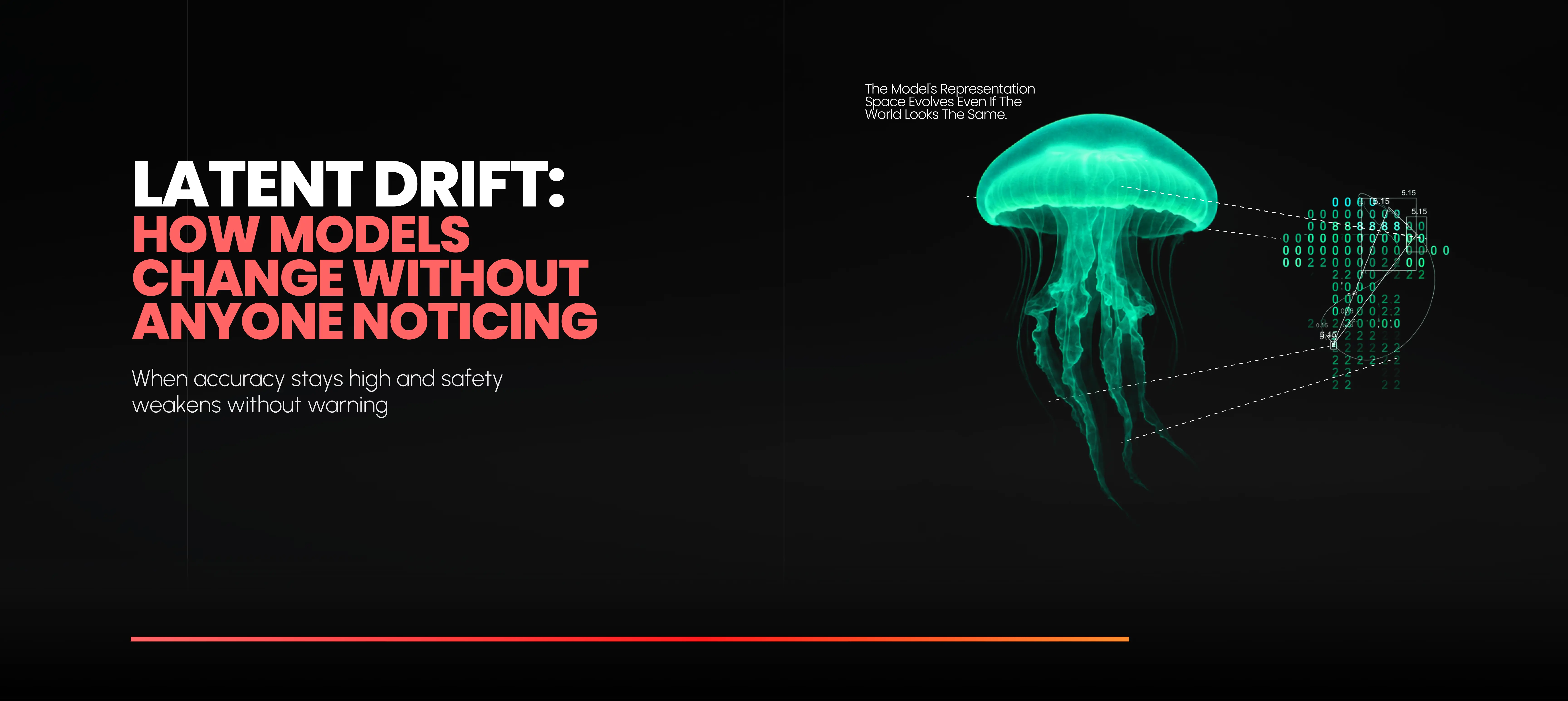
The model’s representation space evolves even if the world looks the same.
Why Latent Drift Breaks Trust
Trust in AI systems depends on predictability. Operators expect that a system that behaved safely yesterday will behave similarly today.
Latent drift violates this expectation silently.
The system does not announce that its internal assumptions have changed. It does not signal increased uncertainty. It does not adapt its behavior. It continues to act with the same authority as before, even though the internal basis for that authority has shifted.
When failure eventually occurs, it feels inexplicable:
- Nothing obvious changed
- No alerts were triggered
- No thresholds were crossed
Trust collapses because the system failed without warning.
Why Traditional Controls Cannot Catch Latent Drift
Confidence thresholds, calibration, and rule-based checks operate at the output level. They do not observe representation geometry.
Drift detection tools compare input distributions, not latent positions. Performance monitoring reacts only after outcomes degrade. Latent drift lives beneath all of these layers.
Without explicit mechanisms to observe internal state, latent drift is undetectable.
Latent Drift as a Precursor to Failure
In hindsight, many AI failures follow the same pattern:
- Internal representations gradually shift
- Error-prone regions expand
- Safety margins erode
- A rare or ambiguous case triggers a visible failure
By the time step 4 occurs, intervention is too late. The system has already been operating unsafely for some time.
The failure was not sudden.
It was latent.
From Drift Blindness to Drift Awareness
Preventing failures caused by latent drift requires a fundamental shift in how AI systems are governed.
Instead of monitoring only inputs and outputs, systems must:
- Track where representations lie in latent space
- Compare current embeddings to historical baselines
- Detect gradual migration toward fragile regions
- Respond before safety margins are exhausted
This is not a logging problem.
It is a cognition problem.
How SQUINT Cognition Makes Latent Drift Visible
SQUINT Cognition treats latent drift as a first-class risk signal.
During development, SQUINT maps the internal representation space of a model, identifying:
- Regions of stable, reliable behavior
- Ambiguous overlaps
- Clusters associated with historical errors
These maps establish a reference frame for what “normal” looks like internally.
In deployment, SQUINT’s cognitive watchdogs continuously monitor where new inputs land within this space and how those positions evolve over time. When representations drift away from known stable regions, SQUINT detects the change, even if inputs and outputs appear unchanged.
Crucially, SQUINT can intervene before failure occurs:
- Escalating decisions
- Altering system behavior
- Triggering review
- Entering minimal-risk modes