Cognitive AI is The Next Scientific Frontier in Machine Intelligence
From Explainability
to Cognition
The first generation of modern AI, statistical AI, focused on optimizing performance through scale: more parameters, more data, deeper networks. The second generation, explainable AI (XAI), sought to interpret model outputs, using saliency maps, feature attributions, and slice discovery to reveal how models behave. While valuable, these approaches remain diagnostic. They help humans analyze errors after the fact, but do not change how models make decisions.
Cognitive AI represents a third generation. It embeds reasoning within the system itself, enabling models to:
Map
the geometry of success and failure in training data.
DETECT
when an input falls into regions of ambiguity or uncertainty.
TRIGGER
adaptive interventions when predictions are unreliable.
Rather than functioning as a black box with a static confidence threshold, Cognitive AI actively monitors its own decision-making and adjusts dynamically. It operationalizes explainability into an ongoing cognitive process.
From Explainability
to Cognition
The first generation of modern AI, statistical AI, focused on optimizing performance through scale: more parameters, more data, deeper networks. The second generation, explainable AI (XAI), sought to interpret model outputs, using saliency maps, feature attributions, and slice discovery to reveal how models behave. While valuable, these approaches remain diagnostic. They help humans analyze errors after the fact, but do not change how models make decisions.
Cognitive AI represents a third generation. It embeds reasoning within the system itself, enabling models to:
Map
the geometry of success and failure in training data.
DETECT
when an input falls into regions of ambiguity or uncertainty.
TRIGGER
adaptive interventions when predictions are unreliable.
Rather than functioning as a black box with a static confidence threshold, Cognitive AI actively monitors its own decision-making and adjusts dynamically. It operationalizes explainability into an ongoing cognitive process.
Intelligence is often mistaken for decisiveness. We admire systems that act quickly, produce confident answers, and rarely hesitate. In artificial intelligence this bias gets amplified. Models that output probabilities close to one are read as strong, while models that express uncertainty are read as weak or undertrained.
That intuition has things the wrong way round.
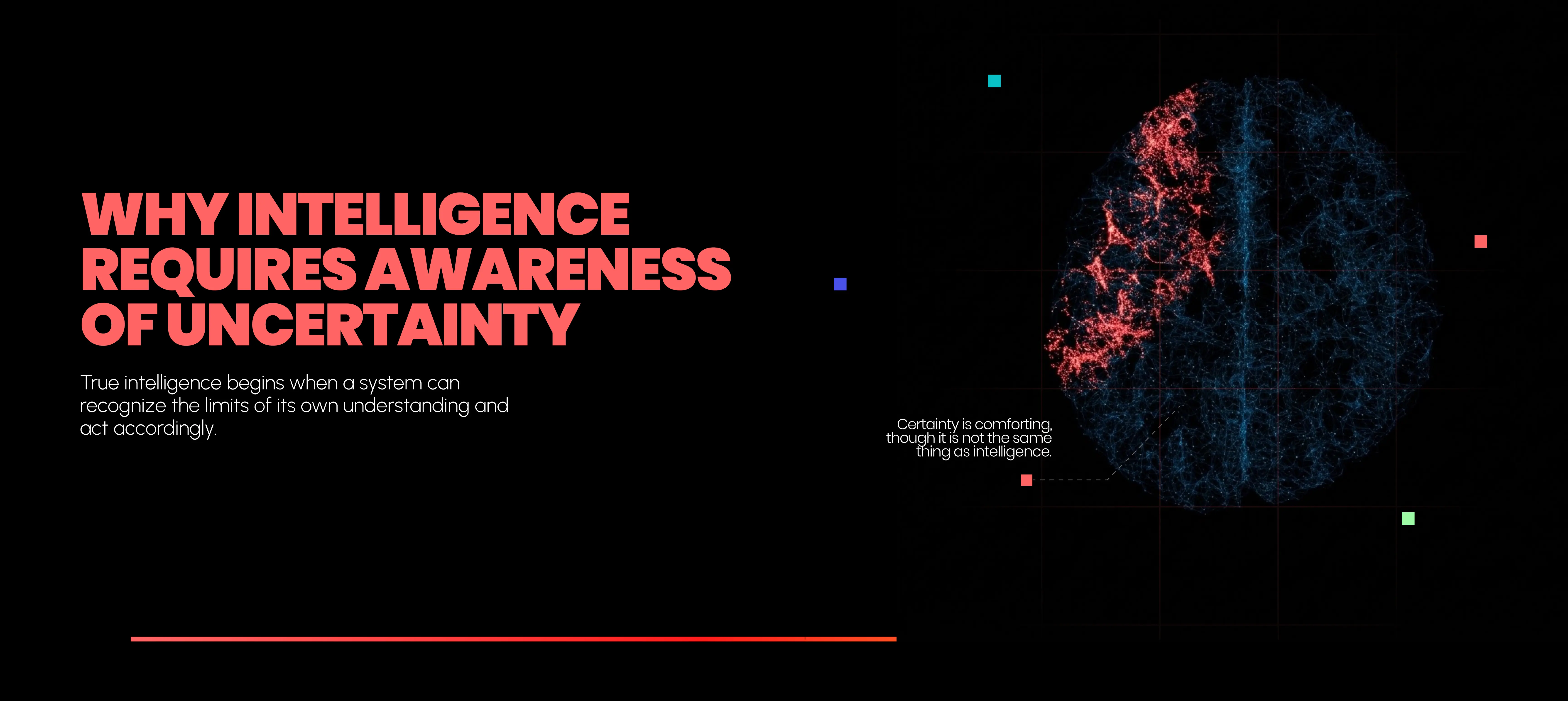
In human cognition and in engineered systems alike, intelligence depends on more than certainty. It depends on recognising when certainty is unwarranted. A system that always acts decisively regardless of context is brittle rather than intelligent. Real intelligence shows up when a system can judge the limits of its own understanding and change its behaviour to match.
For AI systems working in the real world, awareness of uncertainty is a foundation for safe reasoning rather than an optional extra.
Certainty Is Easy,
Judgment Is Hard
Producing an answer is computationally straightforward. A model maps inputs to outputs, picks the most likely option, and reports a confidence score. The process is efficient, it scales, and it suits benchmark evaluation well.
Judgment is a harder thing. It requires answering questions like these:
- Do I understand this situation well enough to act?
- Have similar internal states led to failure before?
- Should I proceed, slow down, or defer?
AI systems are not built to ask any of that. They are optimised to minimise error rather than to evaluate how reliable their own reasoning is. So they treat confidence as correctness, even in the cases where the two come apart.
How uncertainty works in human intelligence
Human intelligence is bound up with uncertainty awareness. We monitor our own confidence constantly and change what we do when it starts to slip.
We hesitate in unfamiliar places. We ask for a second opinion when a case is ambiguous. We slow down when visibility is poor.
These are signs of competence rather than weakness. They prevent errors in exactly the situations where errors cost the most.
The important part is that humans do not clear away uncertainty before acting. They reason while it is still there.
AI systems are built to do the opposite. Their training objectives reward confident predictions, and their architectures give them no way to represent ignorance as a signal in its own right.
Why Modern AI Is Blind to Uncertainty
In most machine learning systems, uncertainty gets reduced to a single number, usually a probability from a softmax function. That number reflects relative preference among the available options rather than any measure of how much the model actually knows.
In technical terms this means three things:
- The model must always choose
- Uncertainty is collapsed into output probabilities
- Ignorance looks the same as confidence
The system has no way to say "I don't know." It can only say "this is my best guess."
That constraint is built into the architecture, and it explains why AI systems often sound most certain at the moments they are least reliable.
Two kinds of uncertainty
Seeing why uncertainty awareness matters means separating two kinds of it.
Aleatoric uncertainty comes from noise or ambiguity inherent in the data, and it cannot be removed. A blurry image or a borderline medical case stays ambiguous no matter how much data you collect.
Epistemic uncertainty comes from a lack of knowledge. It reflects sparse training data, novel contexts, or distribution shift. This kind can be reduced in principle, though only once it has been recognised.
Most AI systems draw no distinction between them. They treat all uncertainty as noise to be averaged away, which leaves epistemic uncertainty hidden and lets the system act as though it understands situations it has never really encountered.
Recognising epistemic uncertainty is what makes caution possible. Without it, intelligence collapses into overconfidence.
What ignoring uncertainty costs
When uncertainty is ignored, a system behaves as though every decision is equally justified. That produces failure modes you can predict in advance:
- High-confidence errors in unfamiliar contexts
- Silent degradation as environments drift
- Abrupt failures in ordinary but underrepresented scenarios
- Inability to adapt when assumptions break
None of these are random. They follow from treating uncertainty as a nuisance instead of a signal. A system that cannot perceive uncertainty has no way to regulate itself.
Uncertainty as
a control signal
In engineering, uncertainty is a critical input to control. Aircraft, power grids and industrial plants all monitor their internal state and adjust their behaviour as uncertainty rises.
AI systems have no equivalent feedback loop. They do not modulate their behaviour based on uncertainty, widen safety margins, become less aggressive, or defer a decision when the evidence is weak.
Awareness of uncertainty is what turns prediction into control.
Reasoning with uncertainty instead of suppressing it
A cognitively aware system works to use uncertainty to guide its behaviour rather than to remove it.
Alongside asking what the most likely answer is, it asks how confident it should be in acting on that answer.
Answering the second question means monitoring internal representations:
- How dense the surrounding region is
- How close the system is to known failure modes
- How stable the representation is over time
- Whether similar states have produced errors before
Uncertainty becomes structural and contextual rather than merely numerical.
How Squint Cognition makes uncertainty actionable
Squint Cognition is built on the principle that uncertainty has to be visible before it can be useful.
During development, Squint maps internal representation spaces to identify:
- Regions of reliable behavior
- Ambiguous overlaps
- Sparse zones associated with epistemic uncertainty
- Clusters linked to past failures